Summary: Frequent flyer points are earned through flights, credit cards and everyday spending, then redeemed for free or heavily discounted flights — including Business and First Class. Australia's three major programs are Qantas Frequent Flyer, Velocity Frequent Flyer and Singapore Airlines KrisFlyer, and joining at least one of them is one of the smartest financial moves any Australian traveller can make.
Let's Dive Into
- 1. What Are Frequent Flyer Points?
- 2. Australia's Three Major Programs Explained
- 3. How Earning Points Works
- 4. How Redemption Works
- 5. Understanding Reward Seats and Award Flights
- 6. The Points Expiry Problem — and How to Avoid It
- 7. Five Mistakes Australian Beginners Make
- 8. Glossary of Key Terms
- 9. Your Next Steps
- 10. Frequently Asked Questions
What Are Frequent Flyer Points?
Frequent flyer points are a loyalty currency issued by airlines that can be redeemed for flights, upgrades and other travel benefits — often saving you thousands of dollars on fares you would have paid in cash.
Think of them like a second currency that exists alongside your regular money. Every time you fly, swipe a linked credit card, shop at a partner retailer or pay a bill through the right program, you earn points. Once you've accumulated enough, you can exchange those points for a flight — sometimes at a fraction of what the same seat would cost in cash.
The difference between a passenger who uses frequent flyer programs strategically and one who ignores them entirely can be tens of thousands of dollars in travel value over a lifetime. Some Australians fly Business Class to Europe every year — on points. Not because they're wealthy. Because they learned how the system works.
That's what this guide is for.
Australia's Three Major Programs Explained
Australia has three major frequent flyer programs worth your attention: Qantas Frequent Flyer, Velocity Frequent Flyer (Virgin Australia), and Singapore Airlines KrisFlyer. Most Australian travellers should be active in at least one of the first two.
Qantas Frequent Flyer
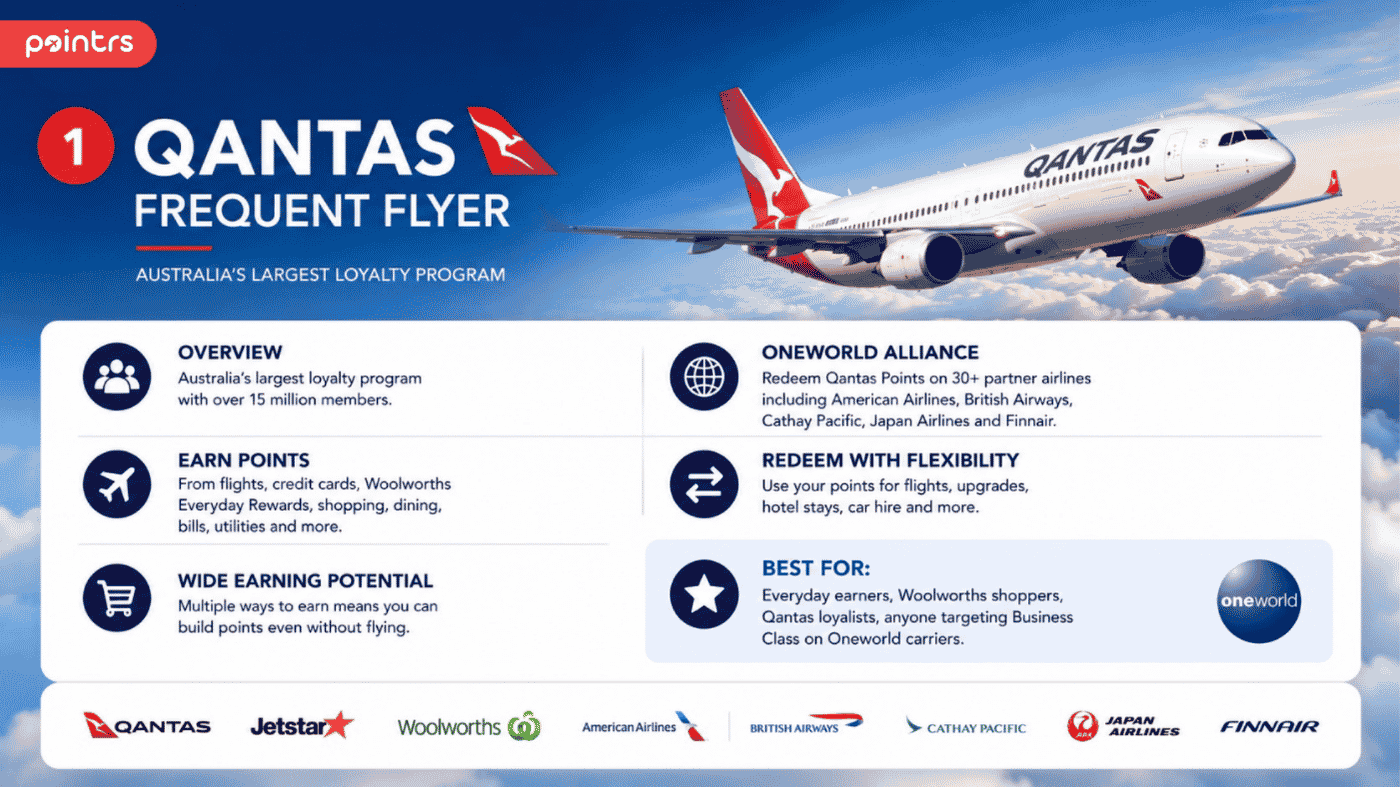
Qantas Frequent Flyer is Australia's largest loyalty program, with over 15 million members. It's operated by Qantas Airways and covers flights on Qantas, Jetstar and more than 30 partner airlines worldwide through the Oneworld alliance.
Points are earned from flights, a wide range of credit cards, Woolworths Everyday Rewards, the Qantas Shopping portal, Qantas Dining, bills, utilities and more. This breadth of earning is Qantas's biggest advantage — it's genuinely possible to build a significant points balance without ever stepping on a plane.
Qantas is a member of the Oneworld alliance, which includes American Airlines, British Airways, Cathay Pacific, Japan Airlines and Finnair. This means your Qantas Points can be redeemed for flights on all of those carriers — not just Qantas itself.
Best for: Everyday earners, Woolworths shoppers, Qantas loyalists, anyone targeting Business Class on Oneworld carriers.
Velocity Frequent Flyer
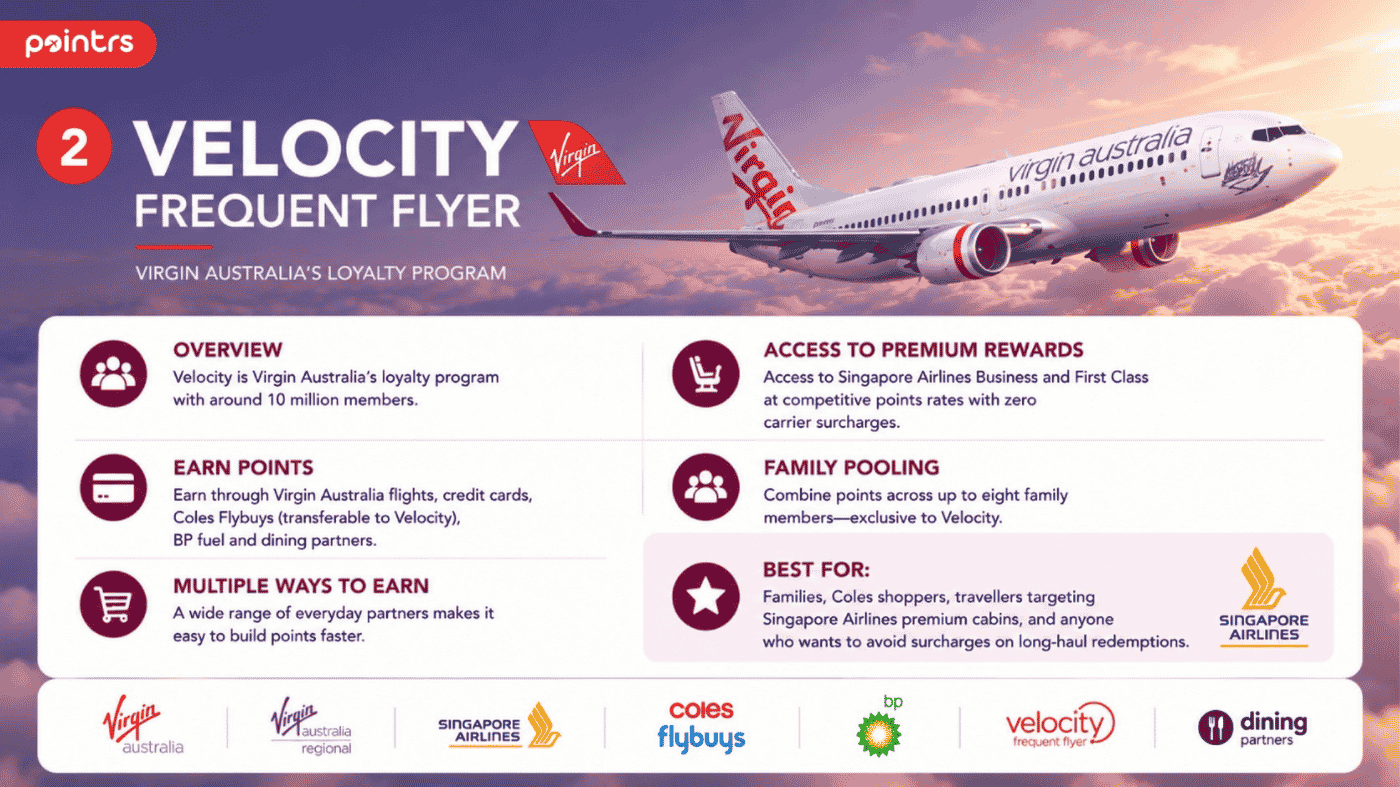
Velocity is Virgin Australia's loyalty program, with around 10 million members. It's smaller than Qantas but has a powerful card up its sleeve: access to Singapore Airlines Business and First Class at competitive points rates with zero carrier surcharges.
Velocity earns through Virgin Australia flights, a range of credit cards, Coles Flybuys (transferable to Velocity), BP fuel, and dining partners. It also offers Family Pooling — the ability to combine points across up to eight family members — which no other major Australian program offers.
Best for: Families, Coles shoppers, travellers targeting Singapore Airlines premium cabins, anyone who wants to avoid surcharges on long-haul redemptions.
Singapore Airlines KrisFlyer
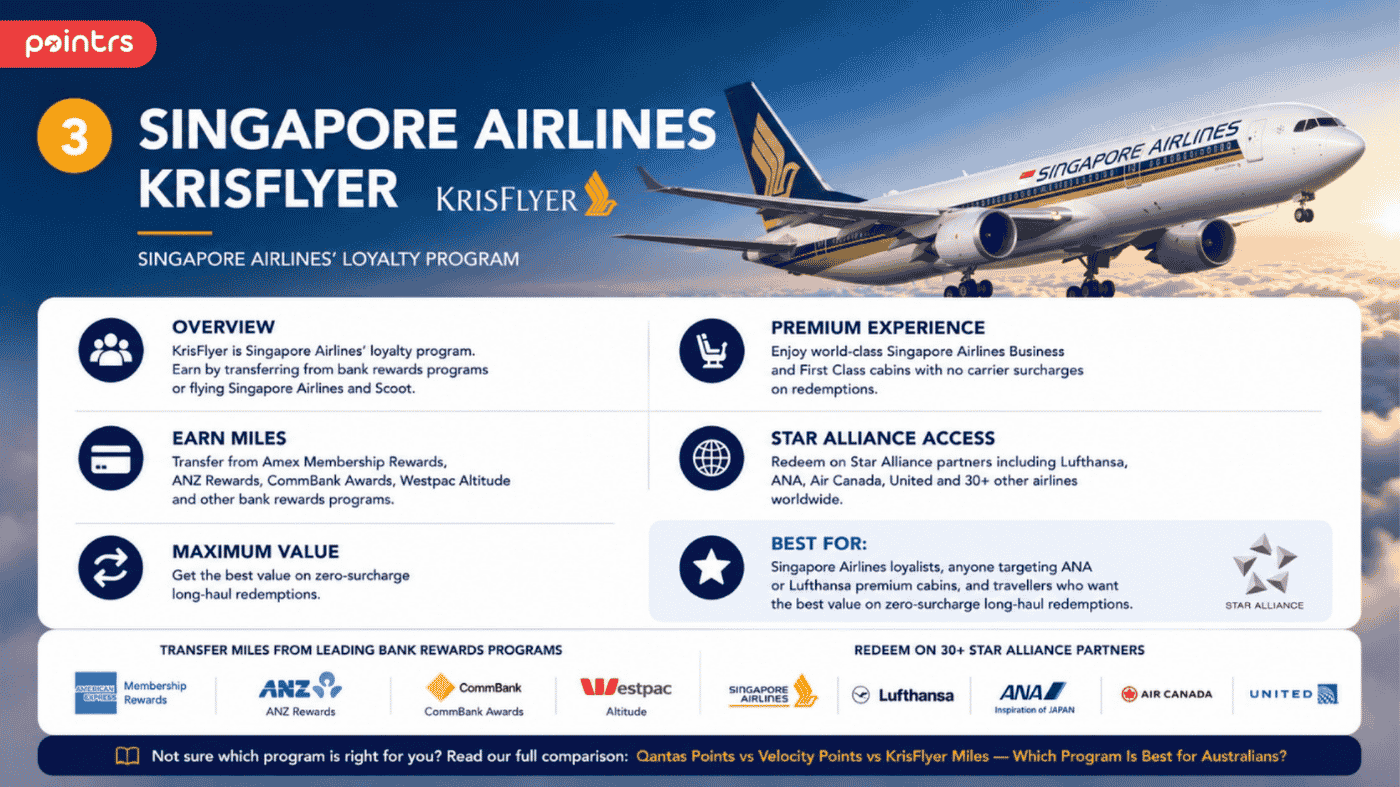
KrisFlyer is Singapore Airlines' program and the third major option for Australian travellers. It has no direct earn cards in Australia — miles are accumulated by transferring from bank rewards programs (Amex Membership Rewards, ANZ Rewards, CommBank Awards, Westpac Altitude and others) or from flying Singapore Airlines and Scoot.
The payoff: Singapore Airlines redemptions carry no carrier surcharges, and the SQ Business and First Class cabin products are among the finest in the world. KrisFlyer also gives access to the Star Alliance network — Lufthansa, ANA (All Nippon Airways), Air Canada, United and 30+ others.
Best for: Dedicated Singapore Airlines travellers, anyone targeting ANA or Lufthansa premium cabins, travellers who want the best value on zero-surcharge long-haul redemptions.
Not sure which program is right for you? Read our full comparison: Qantas Points vs Velocity Points vs KrisFlyer Miles — Which Program Is Best for Australians?
How Earning Points Works
You earn frequent flyer points by flying with your program's partner airlines, spending on a linked credit card, or buying from program partners — including supermarkets, restaurants, online retailers and utility providers.
Earning from Flights
The most obvious method. When you fly on Qantas, Jetstar, or a partner airline, you earn points based on the fare paid, the cabin booked and sometimes the distance flown.
Economy fares on the lowest fare classes earn fewer points per dollar than Business Class or full-fare economy tickets. This is why many experienced points players focus on earning through everyday spending rather than flights alone — the earn rate is more consistent and doesn't depend on which fare type you can afford.
Earning from Credit Cards
Credit cards are the fastest and most powerful way to earn frequent flyer points in Australia — by a significant margin.
When you hold a frequent flyer credit card, every dollar you spend earns points at a set rate — typically 0.5 to 1.5 points per dollar, depending on the card. On a household spending $5,000 per month across all expenses, that's 30,000–90,000 points per year from spending you were going to do regardless.
Top Australian earn cards for each program:
|
Program |
Card |
Earn Rate |
|---|---|---|
|
Qantas FF |
Amex Qantas Ultimate |
Up to 1.25 pts per $1 |
|
Qantas FF |
ANZ Frequent Flyer Black |
1 pt per $1 (uncapped) |
|
Qantas FF |
NAB Qantas Rewards Signature |
0.66–1 pts per $1 |
|
Velocity FF |
Amex Velocity Platinum |
Up to 2.5 pts per $1 |
|
Velocity FF |
Virgin Money Velocity Flyer |
0.66 pts per $1 |
|
KrisFlyer |
Amex MR → KrisFlyer transfer |
Variable by transfer ratio |
Sign-up bonuses — bonus points awarded when you meet a minimum spend threshold in the first few months — are the single biggest single-event points earn available. Top cards currently offer 50,000–120,000 bonus points for meeting an initial spend requirement. That's often enough for a domestic reward flight or a significant contribution toward an international redemption.
Want to know which card to get? Read our full guide: Best Frequent Flyer Credit Cards in Australia 2026
Earning from Supermarkets
Australia is one of the few countries where you can earn meaningful frequent flyer points from your weekly grocery shop.
- Woolworths Everyday Rewards → Qantas Points: Link your Everyday Rewards card to your Qantas Frequent Flyer account. Every $1 spent at Woolworths, BWS and selected Everyday Rewards partners earns points converted to Qantas Points at regular intervals. Everyday Rewards credits convert at 200 credits = 870 Qantas Points.
- Coles Flybuys → Velocity Points: Link your Flybuys card to your Velocity account. Flybuys credits convert to Velocity Points at 500 Flybuys credits = 870 Velocity Points, transferable in any amount above that threshold.
A household spending $200 per week at Woolworths earns approximately 10,000+ Qantas Points per year from groceries alone — before any credit card earn on top.
Earning from Partners
Both Qantas and Velocity have extensive partner earn networks:
- Dining: Qantas Dining and Velocity Dining programs award bonus points at hundreds of participating restaurants across Australia. Register your credit card once; points credit automatically when you dine.
-
Fuel: BP is a Velocity partner. Shell is a Qantas partner. Earn points every time you fill up.
-
Hotels: Earn Qantas or Velocity Points when booking with partner hotel chains.
-
Online shopping: The Qantas Shopping portal and Velocity eStore offer bonus points at hundreds of online retailers — from everyday stores like eBay and Booking.com to fashion, electronics, and more.
-
Bills and utilities: Some providers (including AGL Energy) let you earn Qantas Points on your energy bills. Every dollar counts.
Want to maximise your everyday earn? Read: Best Credit Cards in Australia for Everyday Spending (2026 Guide)
How Redemption Works
You redeem frequent flyer points by using them as payment — in full or in part — for a flight booking. In Australia, the most common and valuable redemption method is a Classic Flight Reward (Qantas) or Reward Flight (Velocity), which offers a fixed points cost for a specific route.
Classic Flight Rewards vs. Points + Pay
Most programs offer two redemption approaches:
Classic Flight Rewards (Fixed Points): You pay a set number of points for a specific route, regardless of the cash price of the seat. This is the best-value option for premium cabin bookings — a Business Class seat worth $10,000 might cost 280,000–318,000 points, saving you the majority of the cash fare.
Points + Pay / Points Upgrade: You use a smaller number of points to reduce the cash cost of a flight, or bid to upgrade your seat using points. Useful for flexible situations, but generally offers lower points value than a full Classic Reward redemption.
How Much Value Are Your Points Worth?
Points value is measured in cents per point — how much cash value you extract per point redeemed.
|
Redemption Type |
Approximate Value |
|
Qantas Points — economy, short haul |
0.8–1.2 cents/point |
|
Qantas Points — Business Class, long haul |
2.0–3.5 cents/point |
|
Velocity Points — SQ Business Class |
2.5–4.0 cents/point |
|
KrisFlyer — SQ Business/First Class |
3.0–5.0+ cents/point |
|
Points for merchandise or gift cards |
0.5–0.8 cents/point |
The pattern is clear: premium cabin long-haul redemptions deliver the highest value per point. Redeeming for merchandise, gift cards or economy seats on short routes is almost always the lowest-value use of your points.
The Surcharge Problem
One of the most important things every Australian points beginner needs to understand: Qantas-operated flights carry carrier-imposed surcharges that can add $400–$900+ in cash to what looks like a "free" reward booking.
These surcharges are on top of your points. They're not government taxes (which are unavoidable) — they're an additional charge Qantas adds to your reward booking.
The fix: book reward seats on American Airlines–operated flights using Qantas Points, or use Velocity Points for Singapore Airlines redemptions. Both options dramatically reduce surcharges — sometimes to just $20–$100 total.
Full details on avoiding surcharges: How to Fly Business Class Using Qantas Points (and Avoid Paying Thousands in Surcharges)
Understanding Reward Seats and Award Flights
A reward seat (or award seat) is a seat on a flight that an airline has made available for points redemption. They are limited in number, released at the airline's discretion, and require advance planning to find on popular routes.
This is where most beginners get frustrated. You've accumulated 200,000 points, you try to book a Business Class flight to London, and the website shows no award availability. What's happening?
Airlines release a small number of seats per flight as reward seats. On popular routes (Sydney–London, Melbourne–Los Angeles), those seats fill up quickly — especially around school holidays, Christmas and peak summer travel.
How to Find Reward Seats
Book early. Qantas typically releases its award seat inventory when the schedule opens — around 11–12 months before departure. That's when availability is highest. Waiting until 3 months out means picking over what's left.
Be flexible on dates. Reward availability varies dramatically by date. Tuesday and Wednesday departures typically have more availability than Friday or Sunday. Shoulder seasons (April–May, September–October) beat peak season almost every time.
Search directly. Use the Qantas website (qantas.com) or Velocity website (virginaustralia.com) to search for award availability. Third-party tools exist but may not reflect real-time inventory accurately.
Consider partner airlines. Your Qantas Points can book reward seats on British Airways, Japan Airlines, American Airlines and other Oneworld partners. Your Velocity Points can book Singapore Airlines. Partner award inventory is often easier to find than Qantas-operated seats on the same route.

The Points Expiry Problem — and How to Avoid It
Most Australian frequent flyer points expire after a period of account inactivity — meaning if you haven't earned or redeemed any points within the program's window, your entire balance is forfeited.
Expiry windows by program:
|
Program |
Inactivity Period Before Expiry |
|
Qantas Frequent Flyer |
18 months |
|
Velocity Frequent Flyer |
24 months |
|
Singapore Airlines KrisFlyer |
36 months |
The fix is simple: any earn or redemption transaction resets the expiry clock. You don't need to spend a lot — a single purchase through the Qantas Shopping portal, a meal at a Velocity Dining restaurant, or even a small points transfer is enough to keep your balance alive.
Set a calendar reminder every 12 months to check your balance and make a small transaction if needed. Don't let years of accumulated points disappear because you forgot to reset the clock.
Five Mistakes Australian Beginners Make
Most beginners lose significant value through predictable, avoidable mistakes. Here are the five most common — and exactly how to avoid them.
Mistake 1: Redeeming Points for Economy on Short Routes
Economy Class redemptions on domestic or short-haul routes (Sydney to Melbourne, Melbourne to Singapore) tend to offer poor value — often less than 1 cent per point. The same points applied to a Business Class long-haul redemption can deliver 3–5 cents per point. Save your balance for the big trip.
Mistake 2: Spreading Points Across Too Many Programs
8,000 Qantas Points and 6,000 Velocity Points and 5,000 KrisFlyer Miles. None of it goes anywhere. Pick a primary program and concentrate your earn there until you have a balance large enough to redeem. Use the others as secondary options for specific redemptions.
Mistake 3: Paying Cash Surcharges Without Realising It
Booking a Qantas Classic Reward and assuming the fee at checkout is just government taxes. It's not — carrier charges can add hundreds of dollars. Read the cost breakdown before confirming any reward booking. Where possible, route through American Airlines–operated segments or use Velocity for Singapore Airlines to avoid them.
Mistake 4: Ignoring the Credit Card Sign-Up Bonus
The fastest single earn event available. New cardholders who meet the minimum spend threshold in the first few months often receive 50,000–120,000 bonus points — sometimes enough for a Business Class upgrade on its own. Beginners who open a card without paying attention to the sign-up bonus miss the biggest opportunity available to them.
Mistake 5: Letting Points Expire
18 months goes faster than you think. Set a reminder. Make a small transaction. Don't lose a balance you spent years building because of an administrative oversight.
Glossary of Key Terms
- Award flight / Reward flight: A flight booked using frequent flyer points rather than cash.
- Classic Flight Reward: Qantas's fixed points pricing structure for award flights. A set number of points per route, regardless of the cash price.
- Carrier charges / Surcharges: Fees imposed by airlines on top of government taxes when you book a reward flight. Qantas-operated flights carry higher surcharges than many alternatives.
- Status credits: A separate currency to points, earned by flying. Status credits determine your loyalty tier (Bronze, Silver, Gold, Platinum) but cannot be redeemed for flights.
- Frequent flyer tier / Status: Your loyalty level within a program, earned through flying. Higher status unlocks lounge access, upgrades, bonus point earning and other benefits.
- Alliance: A group of airlines that share benefits, earning and redemption — including Oneworld (Qantas, American Airlines, British Airways, Cathay Pacific, Japan Airlines) and Star Alliance (Singapore Airlines, Lufthansa, ANA, Air Canada, United Airlines).
- Transfer partner: A hotel or bank rewards program that lets you convert points into frequent flyer miles. Example: Amex Membership Rewards → Qantas Points.
- Reward seat / Award seat: A seat on a flight made available by the airline for points redemption. Limited in number and released at the airline's discretion.
- Oneworld Classic Flight Reward: A special Qantas redemption allowing multi-carrier, multi-stop Business Class itineraries across Oneworld airlines for a flat 280,000 points (return).
- Points pooling / Family pooling: The ability to combine points from multiple household members into one account (available in Velocity Frequent Flyer for up to 8 family members).
- Earn rate: How many points you earn per dollar spent — on a flight or through a credit card or partner.
- Cents per point: A measure of how much value you extract per point redeemed. Higher is better. Business Class long-haul redemptions typically yield 2.0–5.0 cents per point; merchandise redemptions often yield less than 1 cent.
Your Next Steps
You now understand how the system works. Here's where to go from here:
Step 1 — Join a program (if you haven't already)
Sign up for Qantas Frequent Flyer and/or Velocity Frequent Flyer. Both are free to join. If you shop at Woolworths, link your Everyday Rewards card to Qantas. If you shop at Coles, link your Flybuys card to Velocity.
Step 2 — Choose your primary program
Pick one to focus your earning on. Use our comparison guide to decide: Qantas Points vs Velocity Points vs KrisFlyer — Which Is Best for Australians?
Step 3 — Get the right credit card
A frequent flyer credit card will be your single biggest source of points. Read our breakdown of the best options: Best Frequent Flyer Credit Cards in Australia 2026
Step 4 — Start earning on everyday spending
Activate your shopping portal, register for your airline's dining program, and make sure every dollar of everyday spending is earning points. Read: [How to Earn More Qantas Points from Everyday Spending in Australia]
Step 5 — Find your first redemption
Once you have a target balance in mind, start looking at what you could book. Pointrs shows you every available redemption across Qantas, Velocity and KrisFlyer — filtered to what your current balance can unlock.
Frequently Asked Questions
What are frequent flyer points in Australia? Frequent flyer points are a loyalty currency earned through flights, credit card spending and everyday purchases at program partners. They can be redeemed for free or discounted flights — including premium cabins — through programs like Qantas Frequent Flyer, Velocity Frequent Flyer and Singapore Airlines KrisFlyer.
How do I start earning frequent flyer points in Australia? Join a program (Qantas Frequent Flyer and Velocity are both free), link your Woolworths Everyday Rewards or Coles Flybuys card to start earning from grocery shopping, and consider a frequent flyer credit card to earn points on all everyday spending. Those three steps alone will generate meaningful points without changing your lifestyle.
Which frequent flyer program is best in Australia? Qantas Frequent Flyer has the broadest everyday earn network. Velocity is best for families (Family Pooling) and Singapore Airlines redemptions. KrisFlyer is best for those targeting SQ Business and First Class with no surcharges. Most Australians benefit from holding both Qantas and Velocity memberships and using each strategically.
How many points do I need for a free flight in Australia? A domestic reward flight (e.g. Sydney to Melbourne) typically costs 8,000–16,000 Qantas or Velocity Points each way in economy. A Business Class flight to Europe costs 140,000–318,000 points return depending on the program, route and carrier.
Do frequent flyer points expire in Australia? Yes. Qantas Points expire after 18 months of inactivity. Velocity Points expire after 24 months. KrisFlyer Miles expire after 36 months. Any earn or redemption transaction resets the inactivity clock.
Can I earn points without flying? Absolutely. In Australia, credit card spending, supermarket shopping (Woolworths for Qantas, Coles for Velocity), dining at partner restaurants, shopping through airline portals and paying bills with linked cards all generate points without boarding a flight.
What is a reward seat? A reward seat is a limited number of seats on a flight made available by an airline for points redemption. They must be searched and booked in advance — particularly for premium cabins and peak travel dates. Availability is highest when booking 6–12 months ahead.
Is it worth joining a frequent flyer program if I only fly once or twice a year? Yes. Even infrequent flyers accumulate significant points through credit card spending and everyday purchases. Two or three years of consistent earning through the right credit card can fund a Business Class flight without a single status credit earned from flying.
What is the Oneworld Classic Flight Reward? It's a Qantas redemption option that lets you book a multi-carrier Business Class itinerary visiting up to 15 cities across Oneworld airlines for a flat 280,000 Qantas Points return. It's one of the best-value premium redemptions available to Australian frequent flyers.
Ready to Put Your Points to Work?
Understanding the system is step one. Knowing exactly what you can book right now — with the specific balance you already have — is step two.
Pointrs maps every available redemption across Qantas, Velocity and KrisFlyer in real time. Filter by your program, your balance, your destination. See the flights, see the savings, see exactly how many more points you need for your next upgrade.

No spreadsheets. No guesswork. No more wondering if your balance is enough.
Earn More. Spend Less. Travel Better.
Information in this article is accurate as of 2026. Frequent flyer program terms, earn rates, redemption rates and partner arrangements are subject to change. Always verify current terms directly with the relevant program before booking.