Summary:
Frequent flyer programs are free loyalty programs run by airlines that reward you with miles for flying and everyday spending — miles you can redeem for free or deeply discounted flights, including Business and First Class. The fastest way to earn miles in the US isn't flying more — it's choosing the right credit card, using airline shopping portals and dining programs, and concentrating your earn in one program until your balance is large enough to book something meaningful.
Let's Dive Into
- 1. What Is a Frequent Flyer Program?
- 2. The Major US Airline Programs Explained
- 3. How Earning Miles Works
- 4. How Redeeming Miles Works
- 5. Understanding Award Flights and How to Find Them
- 6. The Alliance System — Why It Matters
- 7. Flexible Points vs. Airline Miles — What's the Difference?
- 8. Do Miles Expire?
- 9. Five Mistakes Every Beginner Makes
- 10. Glossary of Key Terms
- 11. Your Next Steps
- 12. Frequently Asked Questions
What Is a Frequent Flyer Program?
A frequent flyer program is a free airline loyalty program that rewards members with miles or points for flying and everyday spending — which can then be redeemed for free flights, seat upgrades and other travel benefits.
The name is a little misleading. You don't have to be a frequent flyer to benefit. Millions of Americans earn the majority of their miles from credit card spending, online shopping, restaurant visits and hotel stays — never from the flights themselves.
Here's what the system looks like in practice: you sign up for a program (free), earn miles through flights and spending, build a balance, and then exchange those miles for a flight that would cost hundreds or thousands of dollars in cash. A domestic round-trip might cost 25,000–35,000 miles. A transatlantic Business Class seat can be booked for 60,000–100,000 miles — on a ticket that retails for $4,000–$8,000.
That's not a coupon. That's a completely different way to travel.
The Major US Airline Programs Explained
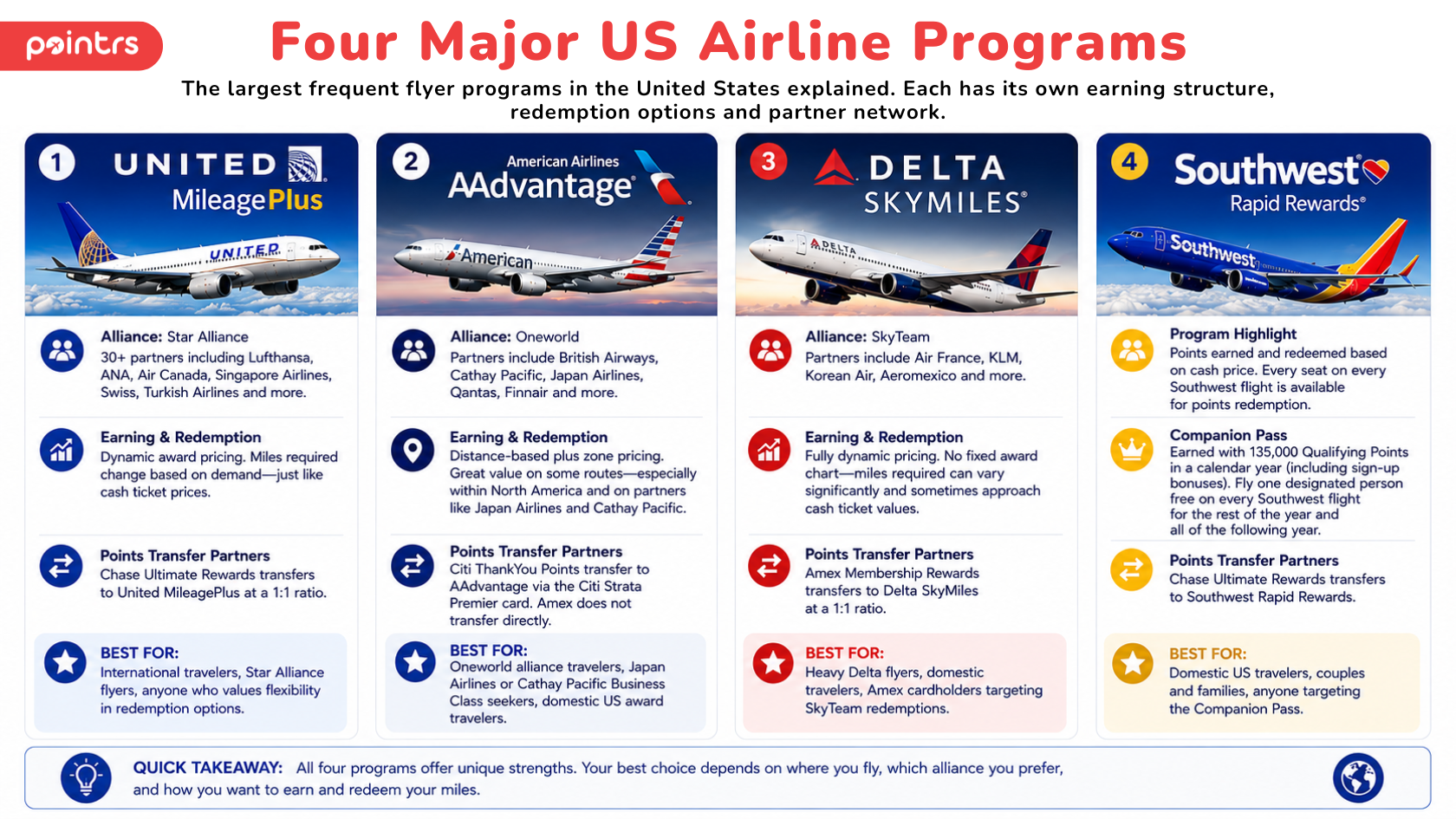
The four largest frequent flyer programs in the United States are United MileagePlus, American Airlines AAdvantage, Delta SkyMiles and Southwest Rapid Rewards. Each has its own earning structure, redemption options and partner network.
United MileagePlus
United's program is one of the most popular in the US and arguably offers the most flexibility for award bookings. United is a member of the Star Alliance — the world's largest airline alliance — giving MileagePlus members access to award seats on Lufthansa, ANA (All Nippon Airways), Air Canada, Singapore Airlines, Swiss, Turkish Airlines, Air China and 30+ others.
MileagePlus uses dynamic award pricing — the number of miles required for a specific flight changes based on demand, just like cash ticket prices. This means popular routes during peak travel periods cost more miles. It also means off-peak redemptions can offer exceptional value.
Chase Ultimate Rewards points transfer directly to United MileagePlus at a 1:1 ratio, making Chase credit cards a natural partner for anyone building a MileagePlus balance.
Best for: International travelers, Star Alliance flyers, anyone who values flexibility in redemption options.
American Airlines AAdvantage
AAdvantage is one of the oldest and largest frequent flyer programs in the world. American is a member of the Oneworld alliance, including British Airways, Cathay Pacific, Japan Airlines, Qantas and Finnair.
AAdvantage uses a distance-based plus zone pricing model — redemption costs are partly based on how far you're flying and the region you're traveling to. This means AAdvantage can offer excellent value on some routes (particularly within North America and on partner carriers like Japan Airlines and Cathay Pacific) while being less competitive on others.
Citi ThankYou Points transfer to AAdvantage via the Citi Strata Premier card. Amex Membership Rewards does not transfer directly to AAdvantage.
Best for: Oneworld alliance travelers, Japan Airlines or Cathay Pacific Business Class seekers, domestic US award travelers.
Delta SkyMiles
Delta's program is the most widely held in the US by number of members. Delta is a member of the SkyTeam alliance, which includes Air France, KLM, Korean Air, Aeromexico and others.
SkyMiles uses fully dynamic pricing — there is no fixed award chart. The miles required for a seat can vary significantly and sometimes approach the cash value of the ticket. This makes SkyMiles harder to extract top value from compared to programs with fixed pricing — but Delta's domestic network is extensive and the program is easy to earn in through Amex co-branded cards and the Delta SkyMiles Shopping portal.
Amex Membership Rewards transfers directly to Delta SkyMiles at a 1:1 ratio.
Best for: Heavy Delta flyers, domestic travelers, Amex cardholders targeting SkyTeam redemptions.
Southwest Rapid Rewards
Southwest's program is unique — and powerful for a specific type of traveler. Rapid Rewards points are earned and redeemed based on the cash price of the flight, not a fixed award chart. Every seat on every Southwest flight is available for points redemption, which means no hunting for limited award space.
The crown jewel of Rapid Rewards is the Companion Pass — earned by accumulating 135,000 Qualifying Points in a calendar year, including sign-up bonuses. The Companion Pass lets one designated person fly with you free on every Southwest flight (cash or points) for the remainder of the calendar year and all of the following year. For couples and families who fly Southwest regularly, it's one of the most valuable perks in travel.
Chase Ultimate Rewards transfers to Southwest Rapid Rewards, making the Chase ecosystem a key path to earning the Companion Pass efficiently.
Best for: Domestic US travelers, couples and families, anyone targeting the Companion Pass.
Other Programs Worth Knowing
Alaska Airlines Mileage Plan: Known for exceptional partner award redemptions. Alaska's partner network includes American Airlines, British Airways, Cathay Pacific, Japan Airlines, Finnair and others — making Mileage Plan one of the best programs for Oneworld Business Class redemptions even if you rarely fly Alaska itself.
JetBlue TrueBlue: Simple, cash-value-based redemption. Good for Northeast US corridor travelers. Points transfer from Amex and Citi.
Air Canada Aeroplan: A rising star in the US market. Amex, Chase and Capital One all transfer to Aeroplan, and its partner network (Star Alliance plus non-alliance partners) makes it excellent for international award bookings — particularly to Europe and Asia.
How Earning Miles Works
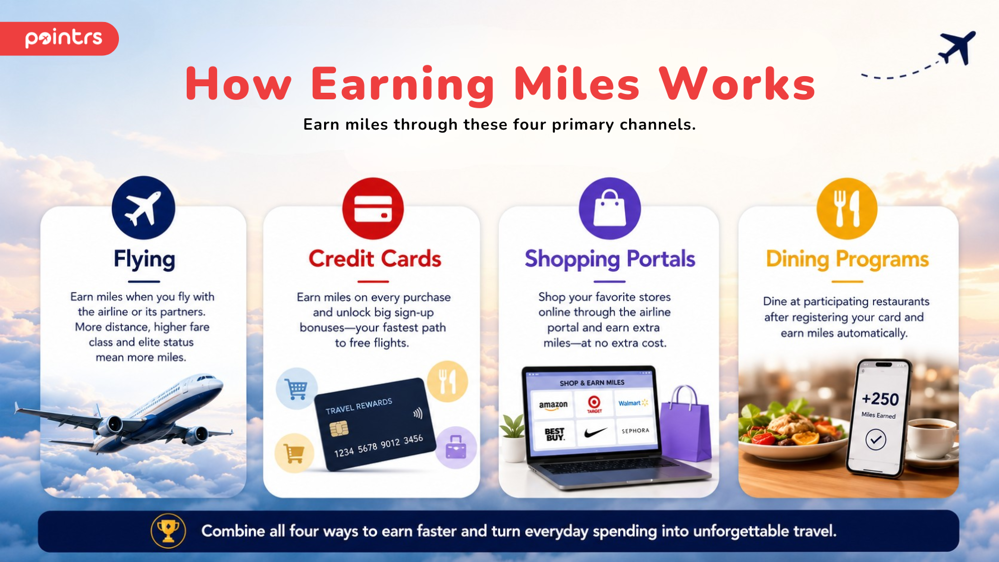
You earn miles through four primary channels: flying with the program's airline or partners, spending on a linked credit card, shopping and dining through program partners, and transferring points from bank rewards programs.
Flying
When you take a flight on a program's airline (or a partner), you earn miles based on the distance flown and the fare class of your ticket. Economy tickets on lower fare classes earn fewer miles; Business Class and full-fare economy earn more. Elite status members earn additional bonuses.
Flying is honest but slow. A round-trip coast-to-coast flight might earn 5,000–10,000 miles. A good credit card earns that from a single month of normal spending.
Credit Cards
Credit cards are the fastest path to a meaningful miles balance — and for most Americans, the single most important earning decision they'll make.
A travel credit card earns miles or flexible points on every purchase you make. The best cards earn 2x–5x on categories like dining, groceries, and travel — turning spending you were going to do anyway into free flights.
The sign-up bonus is the biggest single earn event: top cards currently offer 60,000–100,000+ miles after you meet a minimum spend in the first few months. That one bonus can fund a round-trip Business Class seat.
See our full breakdown: [Best Travel Credit Cards for Earning Points and Miles (2026 Guide)]
Shopping Portals
Every major US airline runs a free online shopping portal that earns bonus miles when you click through to a retailer before purchasing.
The same stores you already use — Amazon, Target, Walmart, Nike, Best Buy, Sephora and hundreds more — often offer 2–10+ miles per dollar when accessed via your airline's portal. It costs nothing, takes seconds and earns on top of your credit card.
Active portals: United MileagePlus Shopping, AAdvantage eShopping (American), Delta SkyMiles Shopping, Southwest Rapid Rewards Shopping.
Dining Programs
Airline dining programs earn miles at participating restaurants when you register your credit card — automatically, with no special app or card required at checkout.
United MileagePlus Dining, AAdvantage Dining, Delta SkyMiles Dining and Southwest Rapid Rewards Dining all work the same way: register your card, dine at a participating restaurant, and miles appear in your account within days. New members often earn 10 miles per dollar for the first 30–90 days as a welcome bonus.
See all earn methods: [How to Earn More Airline Miles and Points Without Flying More]
How Redeeming Miles Works
You redeem miles by using them to pay for a flight, either fully with miles or in a combination of miles and cash. The best-value redemptions are almost always Business and First Class on long-haul international routes.
Award Charts vs. Dynamic Pricing
Some programs use a fixed award chart — a table of set mile costs by route or region. Others use dynamic pricing, where the miles required fluctuate with demand just like cash prices.
|
Program |
Pricing Model |
|
American AAdvantage |
Fixed chart (partner flights) + some dynamic |
|
Alaska Mileage Plan |
Fixed chart |
|
Air Canada Aeroplan |
Fixed chart |
|
United MileagePlus |
Dynamic |
|
Delta SkyMiles |
Fully dynamic |
|
Southwest Rapid Rewards |
Cash-value based |
Fixed charts are generally more predictable and offer clearer sweet spots. Dynamic pricing can deliver good value when demand is low but can also price popular routes at near-cash value.
Where the Real Value Lives
The highest-value redemptions are almost always in Business Class and First Class on long-haul international flights.
A transatlantic Business Class seat worth $4,000–$8,000 in cash might cost 60,000–100,000 miles depending on the program and route. That's 4–8 cents of value per mile — among the best returns available.
Economy on domestic routes typically yields 1–1.5 cents per mile, which is decent but a fraction of what premium cabin international redemptions deliver. If you're accumulating miles specifically for maximum value, think long-haul premium.
Saver vs. Standard Awards
Many programs offer two tiers of award pricing:
Saver / Partner awards: Lower miles cost, but limited seat availability. These are the redemptions to target.
Standard / Everyday awards: Higher miles cost, but more seat availability. Use when you can't find saver space and the cash fare is high.
Understanding Award Flights and How to Find Them
An award flight is a seat on a real commercial flight booked using miles instead of cash. Award seats are limited in number and require advance planning — particularly for premium cabins on popular routes.
Airlines don't make every seat available for miles. They release a controlled number of award seats, and when those are gone, they're gone. This is why "I tried to book with points and there was nothing available" is the most common beginner frustration.
How to Find Award Space
Book early. Most airlines release their schedule 11–12 months in advance. Award availability is highest at that point. Waiting until 2–3 months before departure means competing for whatever's left.
Be flexible with dates. Midweek departures (Tuesday, Wednesday) consistently have better award availability than weekends. Shoulder seasons beat peak holidays every time.
Consider partner airlines. Your United MileagePlus miles can book awards on ANA, Lufthansa, Air Canada and other Star Alliance partners. Your AAdvantage miles can book Cathay Pacific, Japan Airlines and British Airways. Partner award space is often more available than the primary airline's own flights on the same route.
Use the right search tools. Search directly on the airline's website or app for the most accurate award availability. For partner awards, some programs have dedicated search tools. United's search tool shows Star Alliance partner space.

The Alliance System — Why It Matters
Airline alliances are partnerships between airlines that allow members to earn and redeem miles across all member carriers — significantly expanding your redemption options beyond a single airline's own network.
The three major global alliances:
|
Alliance |
Key US Member |
Other Major Members |
|
Star Alliance |
United |
Lufthansa, ANA, Air Canada, Singapore Airlines, Swiss, Turkish Airlines |
|
Oneworld |
American Airlines |
British Airways, Cathay Pacific, Japan Airlines, Qantas, Finnair, Iberia |
|
SkyTeam |
Delta |
Air France, KLM, Korean Air, Aeromexico, Virgin Atlantic |
Why this matters for beginners: your miles don't just unlock your primary airline. A United MileagePlus member can fly Lufthansa Business Class to Frankfurt, Singapore Airlines First Class to Singapore, or ANA Business Class to Tokyo — all on United miles. That's the power of alliances.
Flexible Points vs. Airline Miles — What's the Difference?
Flexible points are earned from bank credit cards and can be transferred to multiple airline programs. Airline miles are earned directly into one program and can only be used within that program's network.
This distinction matters enormously for beginners.
Flexible points programs:
- Chase Ultimate Rewards (transfers to United, Southwest, British Airways, Singapore Airlines, Air Canada, Hyatt and others)
- American Express Membership Rewards (transfers to Delta, Air France, British Airways, ANA, Singapore Airlines, Avianca and others)
-
Capital One Miles (transfers to Air Canada, Turkish Airlines, Singapore Airlines, Air France and others)
-
Citi ThankYou Points (transfers to Turkish Airlines, Avianca, Air France, Singapore Airlines, Cathay Pacific and others)
The advantage: You earn first, then decide which airline program makes the most sense when you're ready to book. If United has award space, transfer there. If Air France is better, transfer to Flying Blue. Flexible points keep your options open.
Airline miles advantages: If you fly one airline consistently, earning directly into that program (especially via a co-branded credit card) earns you status credits alongside miles, unlocking lounge access, upgrades and priority boarding.
The recommendation for most beginners: Start with flexible points. Learn the system. Transfer when you have a specific redemption in mind.
Do Miles Expire?
Yes — most US airline miles expire after a period of account inactivity. The standard window is 12–24 months, and the entire balance is forfeited if you don't make a qualifying earn or redemption transaction within that period.
|
Program |
Inactivity Expiry Window |
|
United MileagePlus |
24 months (no expiry with a Chase co-branded card) |
|
American AAdvantage |
24 months |
|
Delta SkyMiles |
Miles never expire |
|
Southwest Rapid Rewards |
24 months |
|
Alaska Mileage Plan |
24 months |
|
Air Canada Aeroplan |
Miles never expire |
Delta and Aeroplan stand out: neither program expires miles based on inactivity, making them more forgiving options for infrequent travelers.
How to prevent expiry: Any earn or redemption transaction resets the clock. Shopping through a portal, dining at a program restaurant, or making a small credit card purchase all count. Set an annual calendar reminder to check your balance and make a small transaction if you haven't been active.
Five Mistakes Every Beginner Makes
These are the most common — and most costly — mistakes in the points and miles game. Avoid these and you'll be ahead of the vast majority of frequent flyer program members.
Mistake 1: Hoarding Miles Too Long
Miles sitting in your account earn nothing. Airlines can and do devalue their programs — making the same flight cost more miles tomorrow than it does today. Once you have a meaningful balance, identify your target redemption and book it. Don't wait indefinitely for the "perfect" time.
Mistake 2: Redeeming for Cash Back or Gift Cards
Most programs let you redeem miles for statement credits, merchandise or gift cards. The value is almost always terrible — often less than 0.5 cents per mile. The same miles used for a Business Class flight can deliver 5–10x more value. Never redeem points for cash back unless you have no other option.
Mistake 3: Splitting Your Earn Across Too Many Programs
A little United, a little Delta, a little American. None of it adds up to a meaningful redemption in any program. Pick a primary and concentrate. The sweet spot for a first meaningful redemption is 60,000–100,000 miles in a single program. Split across five programs, that takes years. Consolidated in one, it can happen within months.
Mistake 4: Ignoring the Sign-Up Bonus
The sign-up bonus on a travel credit card is the single biggest earn event available. 60,000–100,000 miles in your first few months, just for meeting a minimum spend you'd meet on everyday purchases. Beginners who open a card without activating this bonus are leaving their biggest earn opportunity on the table.
Mistake 5: Not Checking Partner Award Space
Most beginners search for award seats only on their primary airline's own flights. But the real value often sits on partners. AAdvantage miles on Japan Airlines Business Class to Tokyo. United miles on ANA First Class. Aeroplan miles on Lufthansa. Partner redemptions are often better priced and have more availability than the primary airline's own flights on the same route.
Glossary of Key Terms
Award flight: A flight booked using miles or points instead of cash.
Award chart: A fixed table showing how many miles are required for a specific route or region. Not all programs use fixed charts.
Dynamic pricing: Miles pricing that fluctuates with demand, similar to cash ticket prices. Delta and United use dynamic pricing.
Sign-up bonus (welcome offer): Bonus miles awarded when you open a new credit card and meet a minimum spend requirement. Typically the largest single earn event available to new members.
Transfer partner: A bank rewards program or hotel program that allows you to convert points into airline miles. Example: Chase Ultimate Rewards → United MileagePlus.
Alliance: A partnership between airlines sharing award earning and redemption. The three major alliances are Star Alliance, Oneworld and SkyTeam.
Saver award: A lower-cost award redemption with limited availability. The best-value redemption type.
Elite status / Frequent flyer tier: A loyalty level earned by flying a threshold of miles or segments per year. Higher status unlocks lounge access, upgrades, priority boarding and bonus earning.
Companion Pass: Southwest Rapid Rewards benefit allowing a designated companion to fly free on every Southwest flight (cash or points) for up to two years after qualifying.
Mileage run: A flight taken primarily to earn miles or status credits, not for the destination itself.
Cents per point (CPP): A measure of redemption value. Higher is better. Calculate by dividing the cash value of the flight by the number of miles required.
Flexible points: Points earned from bank credit card programs (Chase, Amex, Capital One, Citi) that can be transferred to multiple airline programs.
Co-branded card: A credit card issued in partnership between a bank and a specific airline, earning miles directly in that airline's program.
Your Next Steps
You now understand how the system works. Here's your action plan to go from zero to your first meaningful redemption:
Step 1 — Join a program (or two)
United MileagePlus and American AAdvantage are the most versatile starting points for most travelers. Both are free to join and have extensive partner networks. Southwest Rapid Rewards is best if you fly primarily domestic.
Step 2 — Decide: flexible points or airline-specific?
If you're not sure which airline you'll fly most, start with flexible points (Chase or Amex). If you fly United or Delta consistently, a co-branded card makes sense. Read: [Best Travel Credit Cards for Earning Points and Miles (2026 Guide)]
Step 3 — Activate your portal and dining programs
Register for your primary airline's shopping portal and dining program. Both are free and generate miles from spending you were already doing. Read: [How to Earn More Airline Miles and Points Without Flying More]
Step 4 — Target one redemption
Pick a trip. Figure out how many miles you need. Build toward that balance in one program. Having a specific goal is the single biggest motivator for building a balance efficiently.
Step 5 — Use Pointrs to see what you can book right now
Pointrs shows every available redemption mapped to your current balance across the major programs. No spreadsheets. No forum diving. Just clear, real redemptions you can book today.

Frequently Asked Questions
What is a frequent flyer program? A frequent flyer program is a free loyalty program run by an airline that rewards members with miles for flying and everyday spending. Those miles can be redeemed for free flights, upgrades and travel benefits — often worth many times more than the miles cost to earn.
How do I join a frequent flyer program? Go to the airline's website and sign up for free. United MileagePlus, American AAdvantage, Delta SkyMiles and Southwest Rapid Rewards all have free membership with no minimum activity required to join.
How many miles do I need for a free flight? A domestic round-trip economy award typically requires 25,000–35,000 miles depending on the program and route. A transatlantic Business Class seat can be booked for 60,000–100,000 miles on programs with favorable award charts. The exact amount depends on the program, the route and the time of year.
What's the fastest way to earn miles? The fastest way is a travel credit card with a large sign-up bonus. Top cards offer 60,000–100,000+ miles after meeting a minimum spend requirement in the first few months. Beyond that, using the right card for everyday spending, shopping through airline portals and joining dining programs all compound your earn significantly.
Do airline miles expire? Most programs expire miles after 12–24 months of account inactivity. Delta SkyMiles and Air Canada Aeroplan are notable exceptions — neither expires miles. Keep your account active with at least one earn or redemption transaction per year to prevent forfeiture.
What's the difference between miles and points? The terms are often used interchangeably. "Miles" typically refers to airline loyalty currencies (United miles, Delta miles). "Points" can refer to airline currencies or flexible bank reward currencies (Chase points, Amex points) that transfer to airlines. Functionally, they work the same way — you earn them and redeem them for flights.
Is it better to use miles for economy or Business Class? Business Class on long-haul international routes almost always delivers far better value per mile than economy on domestic or short-haul routes. A Business Class seat worth $5,000 redeemed for 80,000 miles equals 6.25 cents per mile in value. The same miles used for a $300 domestic economy ticket equals less than 0.4 cents per mile.
Can I earn miles on everyday purchases without a credit card? Yes — airline shopping portals, dining programs, hotel transfers and some app-based programs (like Bilt for rent payments) earn miles without requiring a credit card purchase. That said, credit cards remain the most consistent and highest-volume everyday earn method available.
What happens if I can't find an award seat? Search earlier — award space is highest when airlines first release their schedule (typically 11–12 months ahead). Be flexible on dates. Check partner airline availability. Consider different routing options. If a specific flight is sold out for awards, set up an alert and check back regularly — airlines release additional award space as the flight date approaches.
Ready to Go From Zero to Your First Reward Flight?
You've got the knowledge. Now you need the tool.
Pointrs shows you every available redemption across the major US frequent flyer programs — filtered by your balance, your program and where you want to go. Real flights. Real savings. Updated constantly so you're always seeing what's actually bookable right now.
Start exploring with Pointrs →
Earn More. Spend Less. Travel Better.
Information in this article is accurate as of 2026. Frequent flyer program terms, award pricing, transfer partners, earning structures and partner arrangements are subject to change. Always verify current terms directly with the relevant program before booking.