Quick Summary
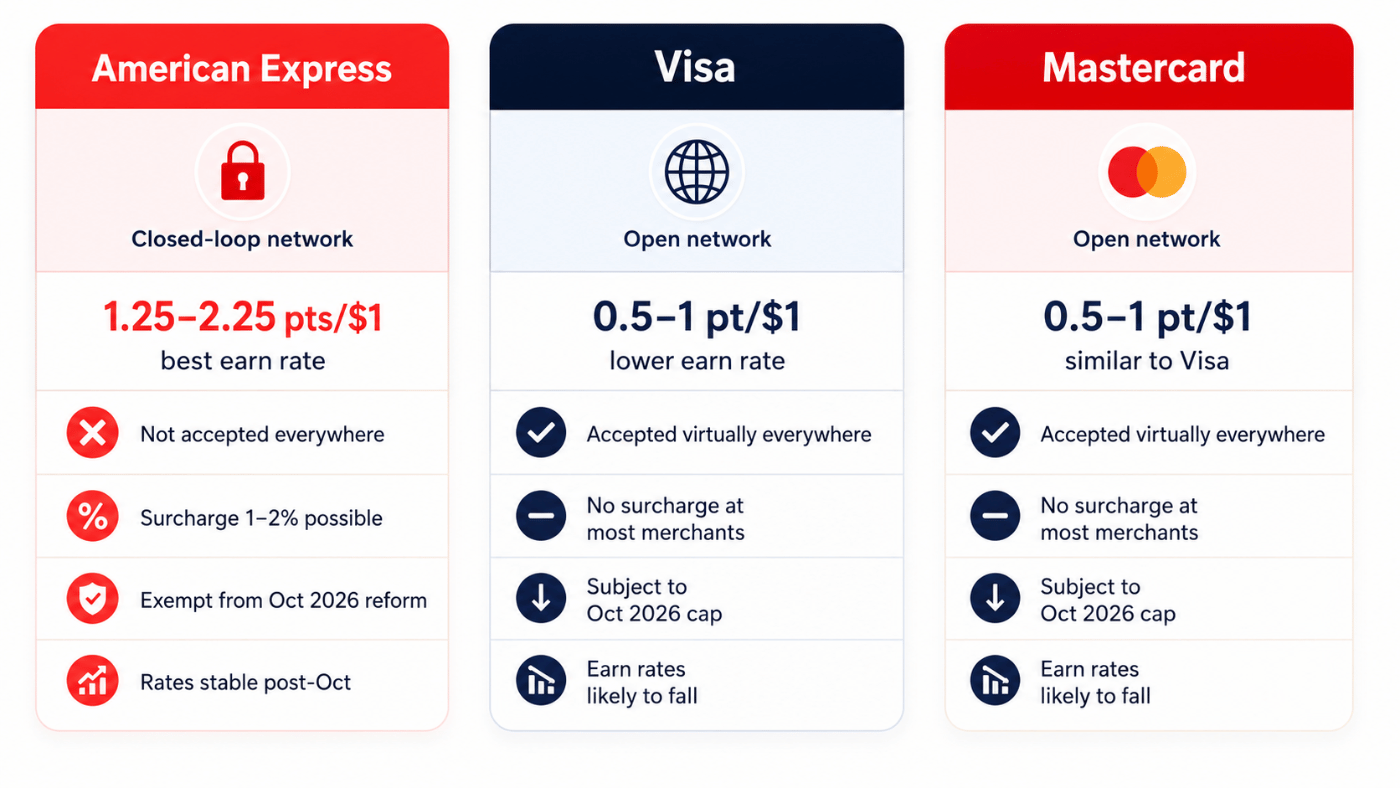
The network on your credit card — American Express, Visa, or Mastercard — determines how many points you earn and where you can use your card. In 2026, Amex wins on earn rates, often delivering 1.25–2.25 Velocity or Qantas Points per $1, compared to 0.6–1 point per $1 on the best Visa and Mastercard rewards cards. But Amex is not accepted everywhere — smaller businesses, some government services, and many regional merchants don't take it, and Amex surcharges of 1–2% can wipe out any points advantage. The choice is further complicated by October 2026: the RBA's interchange fee reform will cut Visa and Mastercard earn rates significantly, while Amex — exempt from the reform — will become comparatively even stronger. The optimal strategy for most Australians is a two-card setup: Amex where accepted (high earn), a no-fee Visa or Mastercard as backup (universal acceptance). This guide shows you exactly how each network stacks up, which cards to consider in each category, and how the October 2026 reform should change your approach right now.
When most Australians think about credit card rewards, they think about the points programme — Qantas or Velocity. What they rarely think about is the card network: the Amex, Visa, or Mastercard logo in the corner.
That logo matters more than most people realise. It determines how many points you earn per dollar, which merchants will accept the card, whether you'll pay a surcharge at the checkout, and — critically after October 2026 — how much that earn rate is likely to change.
From 1 October 2026, the RBA is cutting the consumer credit card interchange fee cap from 0.8% to 0.3%, removing an estimated $910 million in annual revenue from Visa and Mastercard issuers. Several major banks have already indicated they will reduce earn rates, tighten bonus point caps, or raise annual fees on consumer rewards products in response.
American Express and business credit cards are not subject to the new cap. Amex cards have historically offered higher earn rates — often 1.5–2.25 points per $1 on everyday purchases — and this advantage is likely to grow relative to Visa and Mastercard after October.
This guide tells you exactly what the difference between networks means for your points earning right now — and what you should do about it before October.
Does Amex earn more frequent flyer points than Visa or Mastercard in Australia?
Yes — in 2026, American Express credit cards earn significantly more frequent flyer points per dollar than comparable Visa or Mastercard cards in Australia. The Amex Velocity Platinum earns 1.25 Velocity Points per $1 on everyday spend (and 2.25 pts/$1 on Virgin Australia purchases), while the best Visa cards earn around 1 Qantas or Velocity Point per $1. Amex is also exempt from the RBA's October 2026 interchange fee reform, meaning its earn rates are expected to remain stable while Visa and Mastercard earn rates are likely to be reduced. The trade-off is acceptance: Amex is not accepted at all merchants in Australia, and some levy a 1–2% surcharge. The practical solution used by most experienced Australian points collectors is a two-card setup — Amex for high-earn transactions where accepted, Visa or Mastercard as backup everywhere else.
Why the network matters — how interchange fees fund your points
Every time you tap a Visa or Mastercard credit card at a merchant, the merchant pays the bank an interchange fee — currently capped at 0.8% of the transaction value. Part of that fee is what funds your rewards. The higher the interchange, the more the bank can afford to give back to cardholders in points.
American Express operates differently. Rather than routing through a separate bank, Amex operates a closed-loop network — it acts as both the card network and the card issuer, and its merchant fees are structured differently from Visa and Mastercard interchange. This is why Amex is not subject to the RBA's interchange caps, and why it has historically been able to offer higher earn rates.
Several major banks have already confirmed to the RBA that they will respond to the October 2026 revenue reduction by cutting earn rates, tightening bonus point caps, and increasing annual fees on rewards products. This mirrors what happened after the July 2017 interchange reform, when most Australian banks significantly reduced points-earn rates on Visa and Mastercard products.
Act before October 2026
From 1 October 2026, Visa and Mastercard consumer credit card earn rates are expected to fall across most major Australian banks. The ANZ Rewards Black is currently offering up to 180,000 bonus ANZ Reward Points — the strongest Visa rewards offer in the market right now. If you've been considering a Visa or Mastercard rewards card, applying before October locks you into current earn rates and captures the highest available bonus points before the reform takes effect.
American Express — the earn rate leader
Amex cards consistently deliver the highest earn rates available on Australian credit cards. The best personal Amex cards earn 1.25–2.25 points per $1, while the Amex Explorer earns 2 Membership Rewards points per $1 on all purchases.
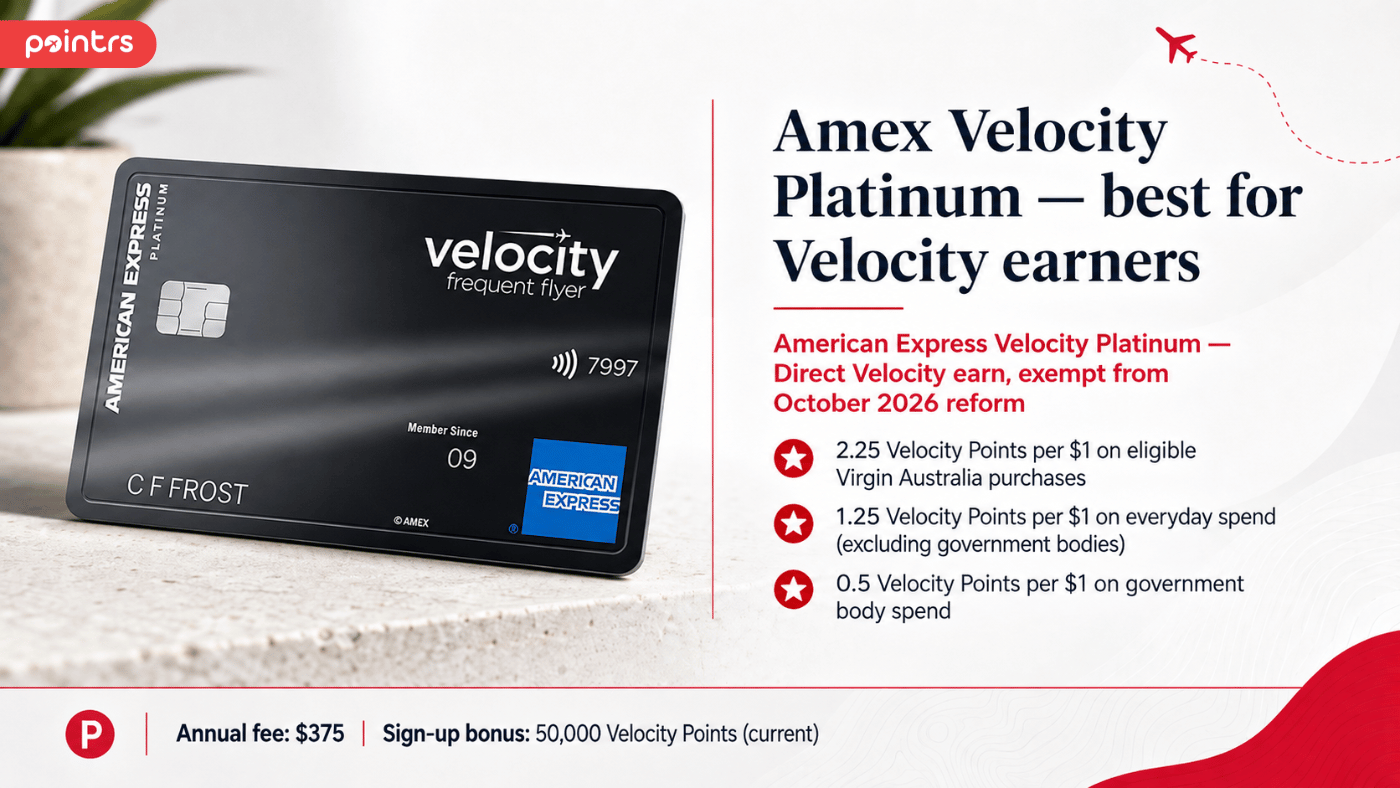
American Express Velocity Platinum — Direct Velocity earn, exempt from October 2026 reform
-
2.25 Velocity Points per $1 on eligible Virgin Australia purchases
-
1.25 Velocity Points per $1 on everyday spend (excluding government bodies)
-
0.5 Velocity Points per $1 on government body spend
-
Annual fee: $375 | Sign-up bonus: 50,000 Velocity Points (current)
The highest direct Velocity earn rate on a personal card in Australia. The 2.25 pts/$1 on Virgin Australia purchases is the best rate available for Virgin loyalists. Earn rates are shielded from the October 2026 RBA reform. Includes a complimentary return domestic Virgin Australia flight, two Lounge Passes, and up to 100 Status Credits per year.
Amex Qantas Ultimate — best for Qantas earners
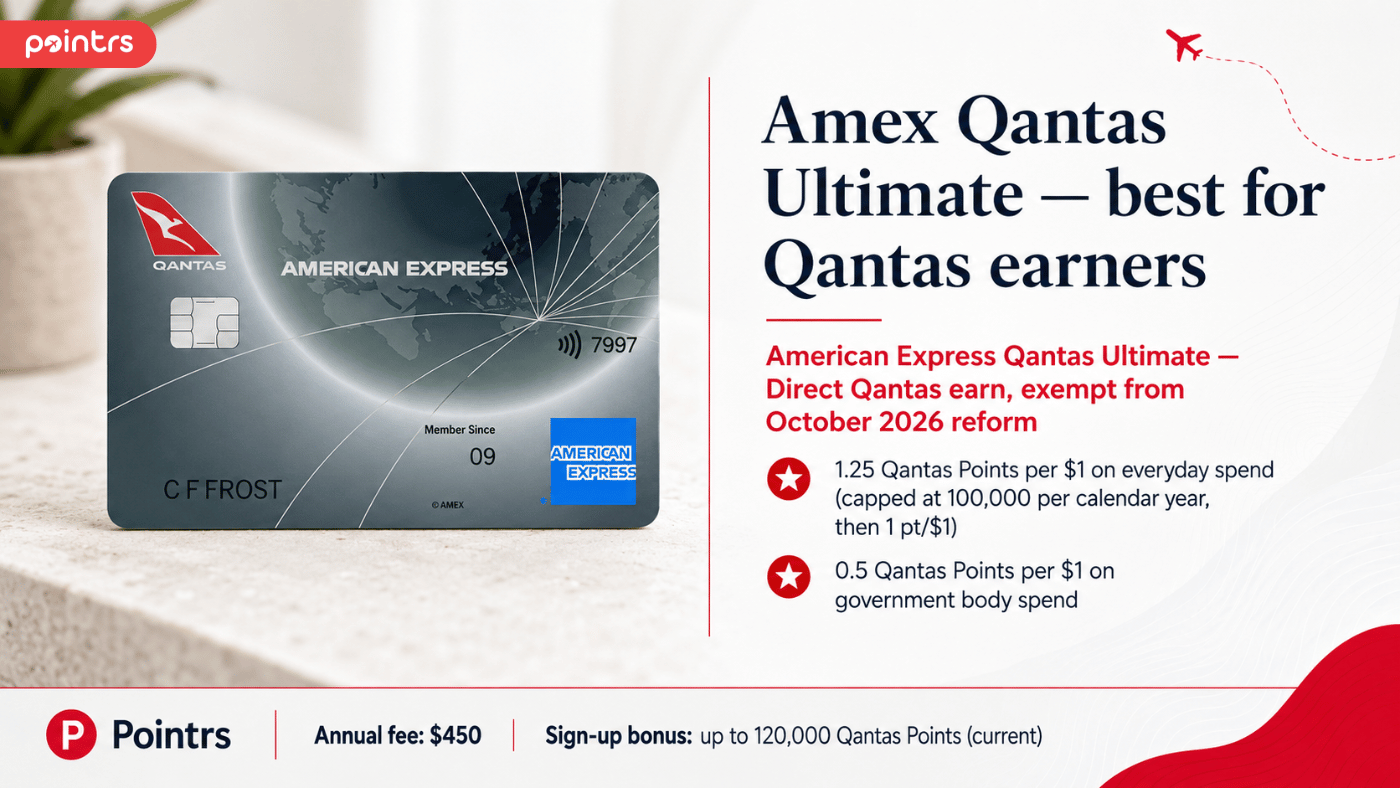
American Express Qantas Ultimate — Direct Qantas earn, exempt from October 2026 reform
-
1.25 Qantas Points per $1 on everyday spend (capped at 100,000 per calendar year, then 1 pt/$1)
-
0.5 Qantas Points per $1 on government body spend
-
Annual fee: $450 | Sign-up bonus: up to 120,000 Qantas Points (current)
The Amex Qantas Ultimate earns 1.25 Qantas Points per $1 on everyday purchases, capped at 100,000 points in a calendar year, then 1 Qantas Point per $1 thereafter. On a household spending $5,000/month, that's approximately 75,000 Qantas Points per year from everyday spend alone — plus the 120,000-point sign-up bonus delivers 195,000+ points in year one. Most Australians pair this with a Visa backup for merchants that don't accept Amex.
Amex Explorer — best for flexible points earners
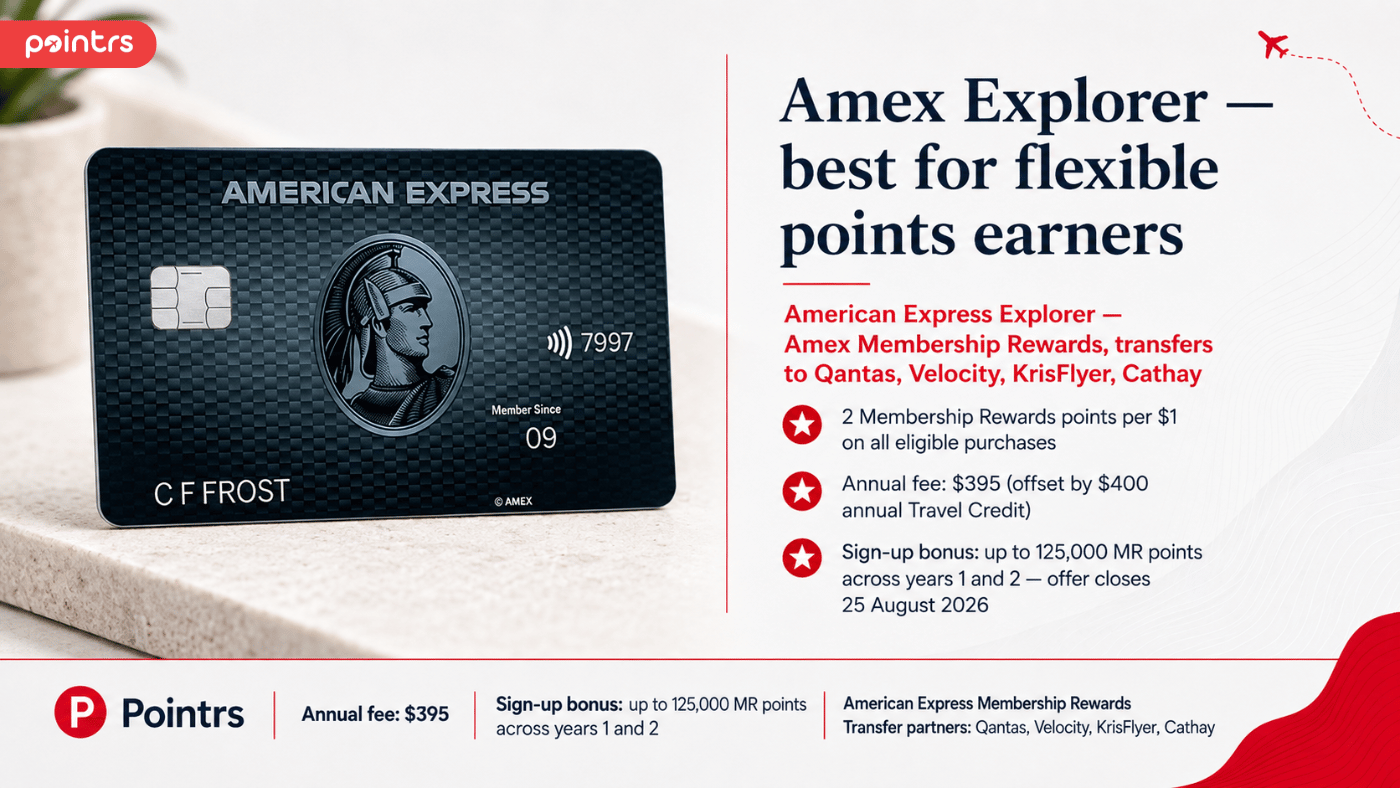
American Express Explorer — Amex Membership Rewards, transfers to Qantas, Velocity, KrisFlyer, Cathay
-
2 Membership Rewards points per $1 on all eligible purchases
-
Annual fee: $395 (offset by $400 annual Travel Credit)
-
Sign-up bonus: up to 125,000 MR points across years 1 and 2 — offer closes 25 August 2026
The Amex Explorer earns 2 Membership Rewards points per $1 on eligible purchases, with a current offer of 75,000 bonus points in year one and 50,000 in year two when spend targets are met, closing 25 August 2026. The $400 annual Travel Credit effectively offsets most of the $395 annual fee.
MR transfers to Qantas at 2:1, Velocity at 2:1, and to Singapore Airlines KrisFlyer and Cathay Pacific Asia Miles at 1:1 — the most program flexibility of any Australian rewards card.
Visa — universal acceptance, lower earn rates
Visa cards trade earn rate for acceptance. They are taken virtually everywhere — every merchant, every ATM, every country — without surcharges. For the everyday Australian who wants simplicity, a Visa rewards card is the path of least resistance.
The limitation: the best Visa-based Qantas earn card in Australia — the ANZ Frequent Flyer Black — earns 1 Qantas Point per $1 on eligible purchases up to $7,500 per statement period, then 0.5 Qantas Points per $1 spent above that cap. That's the best available on a Visa in Australia — already below the Amex Qantas Ultimate's uncapped 1.25 pts/$1.
ANZ Frequent Flyer Black — best Visa for Qantas Points
ANZ Frequent Flyer Black — Direct Qantas earn, Visa, accepted everywhere
-
1 Qantas Point per $1 up to $7,500/month; 0.5 pts/$1 above cap
-
Annual fee: $425 | Sign-up bonus: up to 80,000 Qantas Points across years 1 and 2
-
Includes two Qantas Club Lounge Invitations per year
The ANZ Frequent Flyer Black won Best Qantas Frequent Flyer Credit Card in the 2026 Finder Awards. Bonus structured across two years: 40,000 points for $6,000 spend in first 3 months, plus 40,000 points for keeping the card open 12 months. Best used standalone or paired with an Amex for merchants that don't accept it.
ANZ Rewards Black — best Visa for flexible points
ANZ Rewards Black — ANZ Rewards, transfers to Qantas, Velocity, KrisFlyer at 2:1
-
2 ANZ Rewards Points per $1 (up to $5,000/month cap; effective 1 Qantas or Velocity pt/$1 after transfer)
-
Annual fee: $375 | Sign-up bonus: up to 180,000 ANZ Reward Points — strongest current Visa offer
-
Subject to October 2026 RBA reform — apply before October to capture current earn rates
The ANZ Rewards Black is currently offering up to 180,000 bonus ANZ Reward Points — the strongest Visa rewards offer in the market right now.
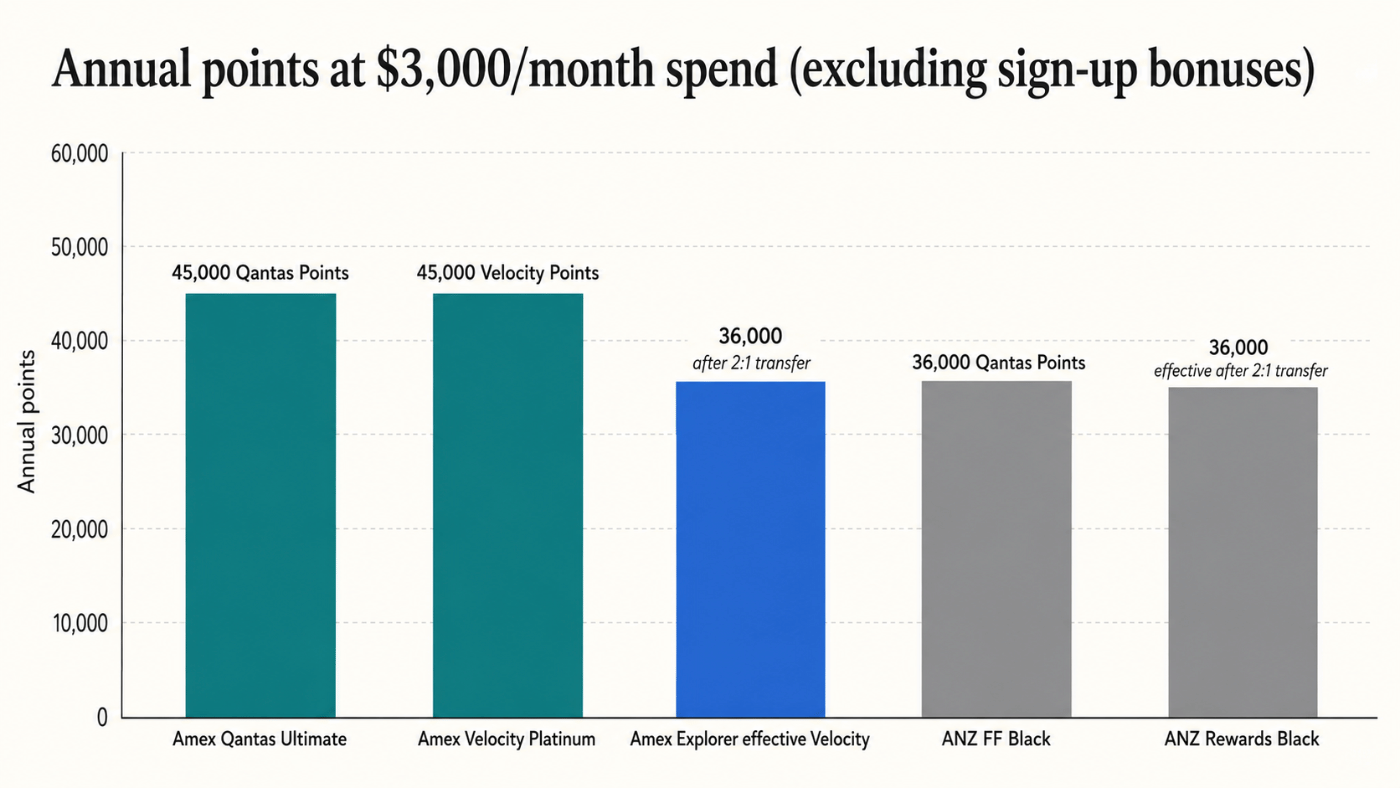
Mastercard — essentially the same as Visa for points purposes
In Australia in 2026, Mastercard and Visa are functionally equivalent for frequent flyer earning. Both are open-loop networks subject to the same RBA interchange caps. Both are accepted everywhere. Both carry earn rates that lag behind Amex.
The most notable Mastercard rewards products for Australian frequent flyers are the CommBank Ultimate Awards card (CommBank Awards points transferable to Qantas or Velocity at 2:1) and the St.George Amplify Signature Mastercard (Amplify Points transferable to Qantas or Velocity).
Neither outperforms comparable Visa products on earn rates. The practical Mastercard worth holding: a no-fee option like the Latitude 28° Global Platinum Mastercard for international travel, which charges no foreign transaction fees.
This two-card strategy — a points card (Amex) for everyday spending in Australia, and a no-fee card for all overseas spending — is used by most experienced Australian travellers.
The two-card strategy — the optimal approach for most Australians
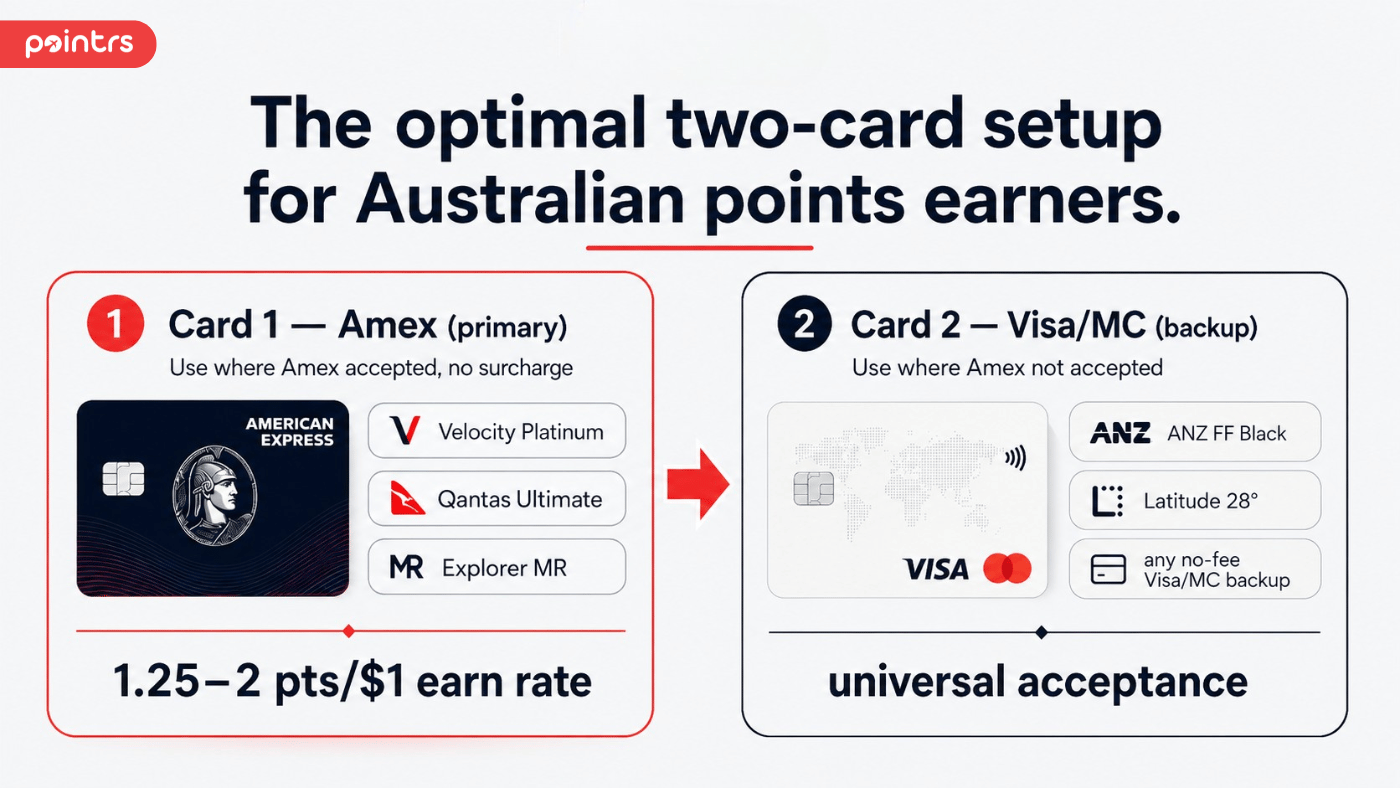 Two Card Setup for Australian Points Earners [Explained]
Here is the practical conclusion most experienced Australian points collectors arrive at: you don't have to choose between Amex's earn rates and Visa's acceptance. You use both.
Card 1 (primary): an Amex rewards card used for all transactions where Amex is accepted without surcharge. This captures the highest earn rate on the bulk of everyday spending — supermarkets, dining, major retailers, online shopping, bills.
Card 2 (backup): a no-annual-fee Visa or Mastercard used exclusively for merchants that don't accept Amex or that levy an Amex surcharge. Ideally with no foreign transaction fee for overseas travel.
A common strategy is to default to Amex Explorer for any transaction where American Express is accepted without surcharge, capturing the higher points earn and using the travel credit annually, and to fall back on ANZ Rewards Black wherever only Visa is accepted or where a surcharge applies to Amex. Used this way, the two cards complement each other and can significantly boost your total annual points haul.
One important note on surcharges: from 1 October 2026, merchants can no longer add a surcharge when you pay by credit card in Australia. The cost of card acceptance must be built into the advertised price instead. This removes one of the remaining friction points with Amex — from October, you should be able to use your Amex at all Australian merchants without a checkout surcharge, although whether the terminal physically accepts Amex varies by merchant.
What your extra points can buy — live Pointrs
The difference between earning 1 pt/$1 on a Visa card and 1.25 pts/$1 on an Amex card at $3,000/month spend is 9,000 extra points per year. Over two years, that gap is 18,000 points. Here is what that gap translates to in real Pointrs available to book right now.
Brisbane to Bali — Economy return — save 34,000 points
Brisbane to Denpasar Economy return on Virgin Australia for 26,000 Velocity Points — versus the standard 60,000. A 57% saving.
👉 See this Pointr: Brisbane to Bali Economy return — 26,000 Velocity Points
Brisbane to Tokyo — Business Class return — save 122,000 points
Brisbane to Tokyo Business Class return on Qantas for 80,000 Qantas Points — versus the standard 202,000. A 60% saving.
👉 See this Pointr: Brisbane to Tokyo Business return — 80,000 Qantas Points
Sydney to Paris — Business Class return — save 256,000 points
Sydney to Paris Business Class return on Qantas via Perth for 170,000 Qantas Points — versus the standard 426,000. A 60% saving.
👉 See this Pointr: Sydney to Paris Business return — 170,000 Qantas Points
👉 Browse all Spend Less Pointrs and see what your points can already buy
👉 Sign up to Pointrs and start earning smarter today
Related guides — AU credit cards and frequent flyer series
-
Best credit cards for Velocity Points in Australia 2026 — compared: The dedicated Velocity card comparison — which card earns fastest, which sign-up bonus is biggest, and the correct tiered earn rates across all major Velocity cards.
-
Best frequent flyer credit cards in Australia 2026 — Qantas vs Velocity vs flexible points: The full across-programme comparison covering all three major AU loyalty ecosystems.
-
Why 3 in 5 Australians think frequent flyer points aren't worth it — and why they're wrong: The foundational case for why the game is worth playing — with real redemptions that prove it.
-
Qantas Points are being devalued — here's how to protect yourself before it's too late: What the August 2025 award chart changes, Amex devaluation, and RBA October 2026 reform mean for your points.
-
You're paying thousands in carrier charges on points flights — stop it now: The most costly hidden fee in Australian frequent flyer travel — and exactly which redemptions to avoid.
-
Why your everyday grocery and fuel spending is your fastest path to free flights in Australia: How to earn 100,000+ Qantas or Velocity Points per year from spending you were already doing.
All card information is accurate as of July 2026. Earn rates, annual fees, sign-up bonuses, transfer ratios, and card benefits are subject to change without notice. Amex Velocity Platinum earn rates: 2.25 pts/$1 on eligible Virgin Australia purchases, 1.25 pts/$1 on everyday spend excluding government bodies, 0.5 pts/$1 on government body purchases. Amex Qantas Ultimate earns 1.25 Qantas Points per $1 capped at 100,000 points per calendar year, then 1 Qantas Point per $1 thereafter. Amex Explorer 125,000 bonus MR points offer (75,000 in year one, 50,000 in year two) ends 25 August 2026. ANZ Frequent Flyer Black earns 1 Qantas Point per $1 up to $7,500 per statement period, then 0.5 pts/$1 above cap. Sign-up bonus of up to 80,000 Qantas Points across years 1 and 2 — verify current offer directly with ANZ before applying. ANZ Rewards Black 180,000 bonus points offer — verify current offer and end date directly with ANZ before applying. RBA interchange fee reform takes effect 1 October 2026 — earn rates on Visa and Mastercard consumer rewards cards are expected to change. Merchant surcharge ban from 1 October 2026 applies to Visa, Mastercard, and eftpos — Amex acceptance at individual merchants may still vary. Transfer ratios from Amex MR and ANZ Rewards to airline programmes are subject to change. Always read the product disclosure statement and consider your personal financial circumstances before applying for any credit product. This is general information only and is not financial advice.