Quick Summary
Carrier surcharges — the cash component you pay on top of your Qantas Points — are the most misunderstood and most costly hidden fee in Australian frequent flyer travel. A Sydney to London Business Class return on Qantas now attracts carrier charges of over $1,296 AUD on top of your points, up from $946 before August 2025. Emirates surcharges are even higher. But not every airline or redemption works this way. American Airlines, Singapore Airlines on its own flights, Japan Airlines, and Air Canada Aeroplan carry significantly lower or zero carrier charges on most routes — and Pointrs shows you exactly which redemptions extract the most value from every point you have, without handing a chunk of it back to the airline in cash.
Here is a scenario that plays out thousands of times every week for Australians who think they've scored a free flight.
They spend months earning Qantas Points. They find a Classic Reward seat. They go to book — and then they see it. Fees, taxes, and carrier charges. Sometimes $400. Sometimes $700. On some long-haul Business Class bookings, over $1,000. In cash. On top of the points.
The "free flight" wasn't free at all. And the reason most people don't see it coming is that Qantas's own website makes the surcharges surprisingly hard to predict in advance.
Carrier charges — also called fuel surcharges — are amounts airlines impose on top of legitimate government taxes and airport fees when you book a reward seat. On routes between Australia and Vancouver, Dallas, New York and Santiago, the Qantas carrier charges alone on a return Business Class booking are now $1,050, up from $430 — a 144% increase that took effect alongside the broader award chart changes in August 2025.
That's $1,050 in cash. Before a single government tax. Before airport fees. Just the airline's own surcharge, on a seat you're also paying 130,000–260,000 Qantas Points for.
If this has happened to you, you're not alone. If it hasn't happened to you yet, this article is going to make sure it doesn't.
What are carrier surcharges on Qantas reward flights, and how do you avoid them?
Carrier surcharges (also called fuel surcharges) are cash fees that airlines impose on reward seat bookings, on top of government taxes and airport fees. On Qantas Classic Rewards, these charges range from around $35 per sector on short domestic flights to over $648 per return sector on long-haul Business Class routes. The best ways to avoid or minimise carrier surcharges are: redeeming Qantas Points on American Airlines flights (which add no carrier surcharge), booking Singapore Airlines flights through KrisFlyer miles (which charges no surcharges on its own metal), and using Air Canada Aeroplan to book partner flights on carriers with low or zero surcharges. Pointrs' Spend Less section shows you exactly which redemptions carry the lowest fees for any given route.
Why carrier surcharges exist — and why Qantas's are so high
Carrier surcharges have a history that most frequent flyers don't know about. They were introduced during oil price spikes in the 2000s as a way for airlines to quickly adjust ticket prices without reprinting fare tables. When oil prices fell, the charges stayed — and in most cases, grew.
Qantas doesn't exactly make it easy to work out their surcharges on Classic Flight Reward redemptions. They apply on a per-sector basis, vary by route and cabin, and are not clearly displayed when you search for reward availability. You only see the full cash component when you get to the payment screen — at which point you've already found the seat and committed mentally to the booking.
The August 2025 changes made this significantly worse. Most flight awards increased by 10–20% in the number of points required, and there was a similar increase in the already high carrier surcharges that Qantas collects. Premium cabin surcharges — the ones that hit Business and First Class redemptions — were increased the most, with Qantas aligning Classic Reward carrier charges to the same level as Classic Plus bookings.
Key surcharge figures (post August 2025, Business Class return):
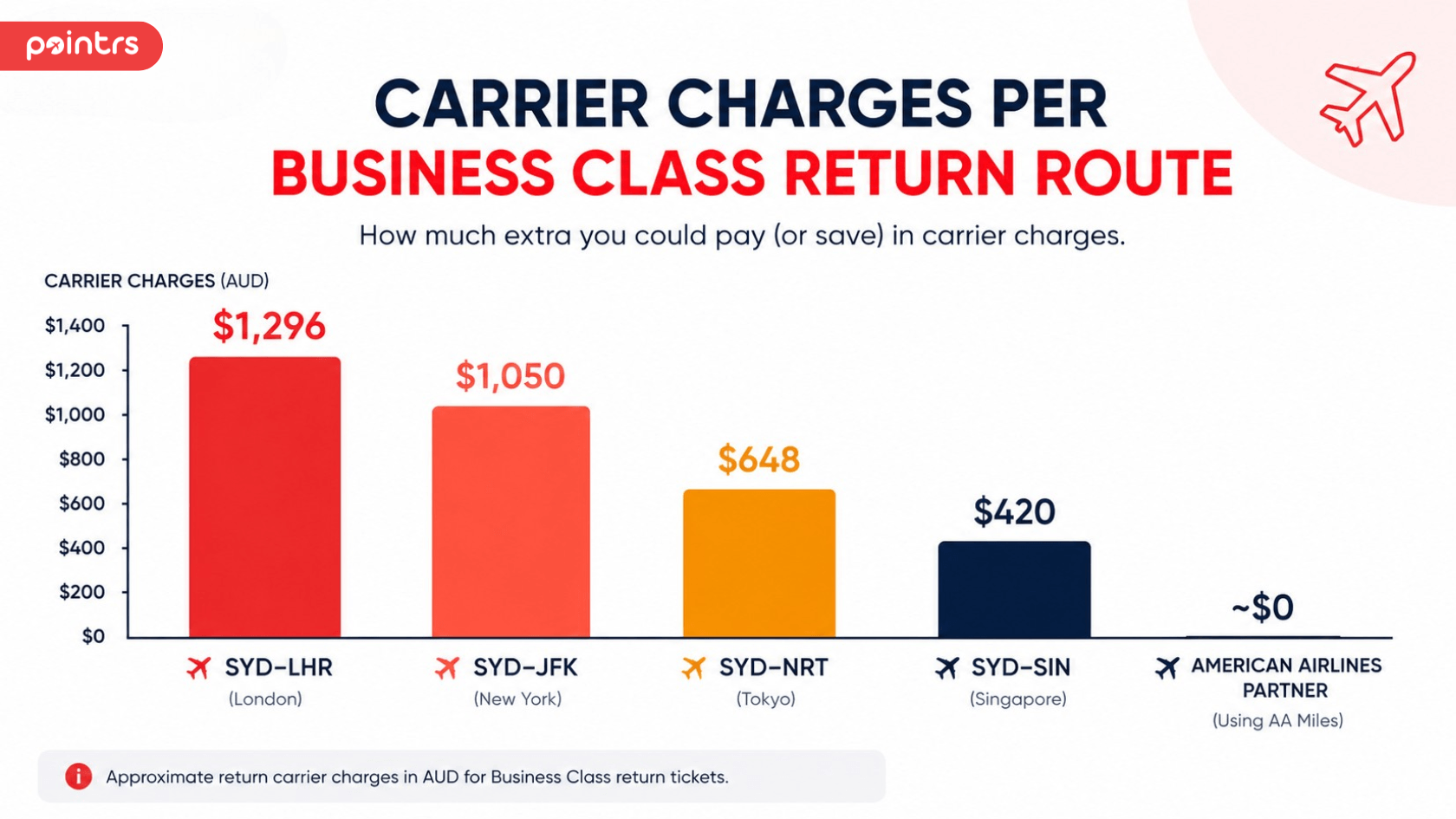
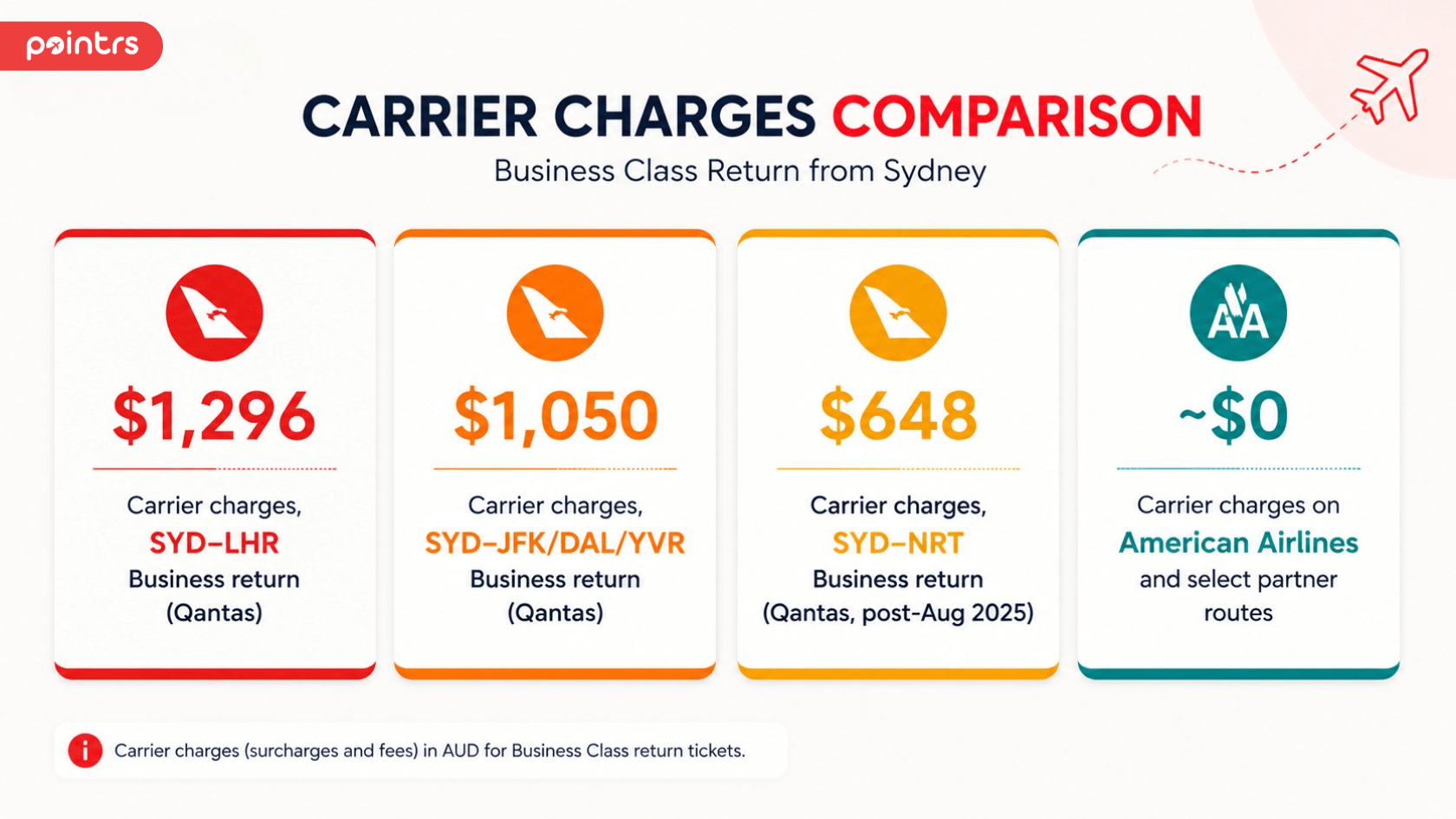
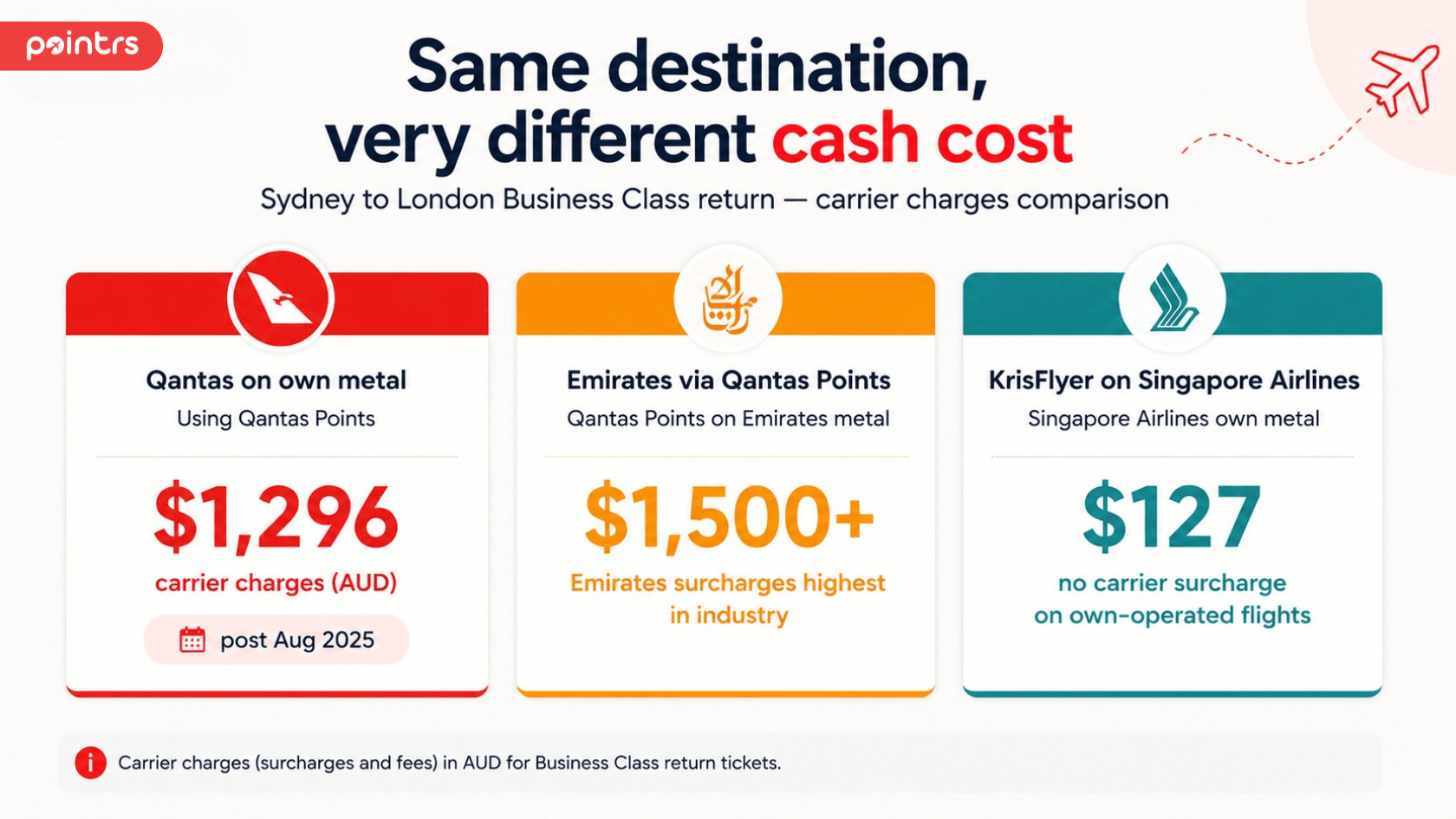
- $1,296 AUD — Sydney to London (Qantas operated)
- $1,050 AUD — Sydney to New York / Dallas / Vancouver / Santiago (Qantas operated)
- $648 AUD — Sydney to Tokyo (Qantas operated, post Aug 2025)
- $420 AUD — Sydney to Singapore (Qantas operated)
- ~$0 — American Airlines routes via Qantas Points
Emirates's surcharges are even higher. Emirates is now known to have the highest carrier charges in the industry, costing hundreds of dollars per sector. For Australians redeeming Qantas Points on Emirates — a popular option given the Dubai hub — the cash component can significantly undermine the value of the redemption.
The airlines and programs with low or zero carrier surcharges
Here is the key fact that most Australians in the points game either don't know or don't act on: carrier surcharges are not universal. They vary dramatically by airline and by the program you use to book.
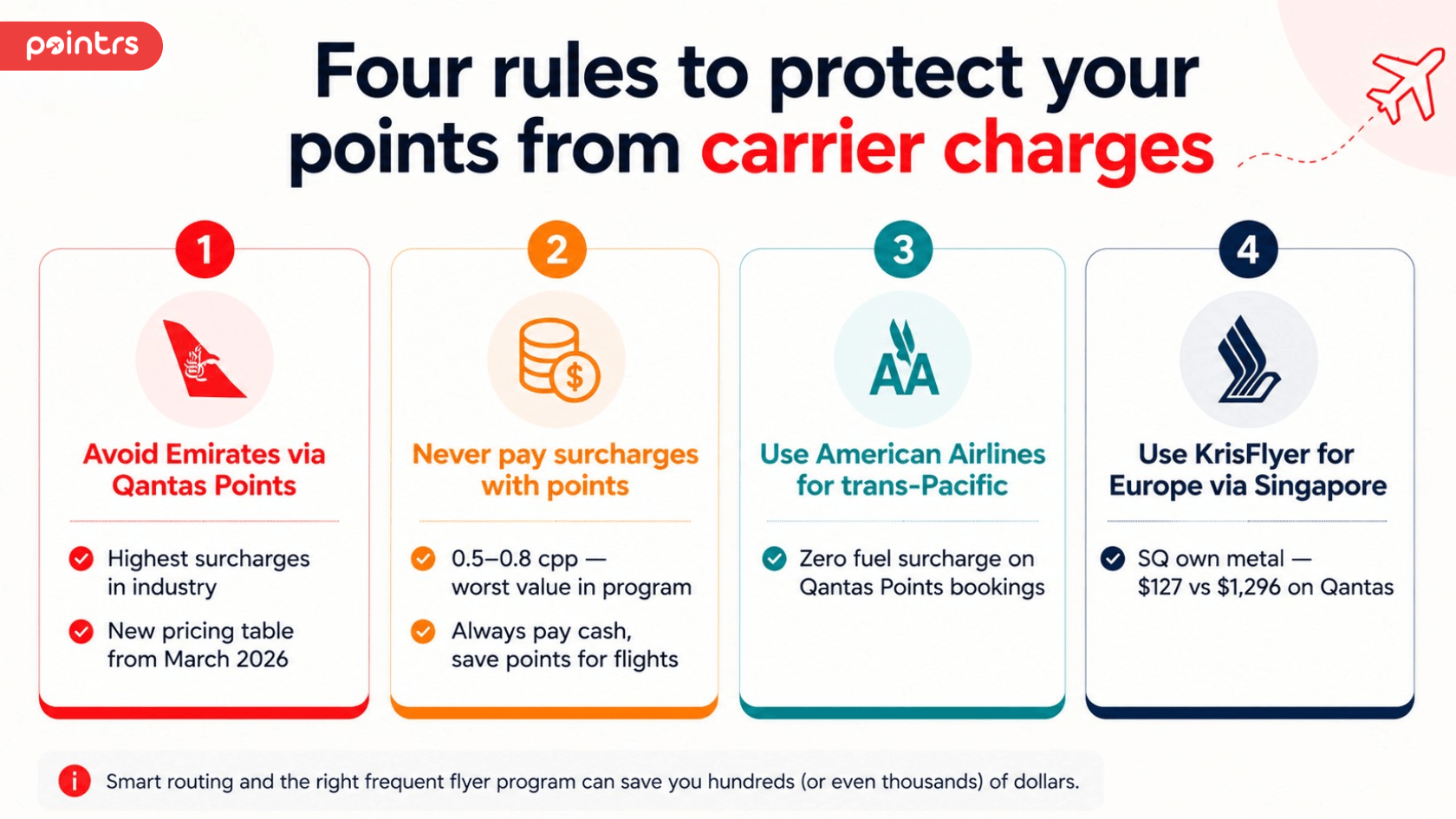
American Airlines — no fuel surcharge on Qantas reward bookings
Some airlines, including American Airlines, do not add fuel surcharges when you book their flights using Qantas Points. This makes American Airlines one of the best-value redemption options in the entire Qantas partner network for routes where they operate — particularly trans-Pacific flying to the US and connecting onward to a huge domestic network.
A Qantas Points redemption on American Airlines from Sydney to Los Angeles, connecting to a domestic US destination, carries only legitimate government taxes and airport fees — no fuel surcharge imposed by either Qantas or American. On a Business Class return, this can represent a saving of $600–$1,000 AUD versus the equivalent Qantas-operated flight.
Singapore Airlines KrisFlyer — no surcharges on Singapore's own flights
Singapore Airlines does not apply any carrier charges to its own flights when you book through KrisFlyer. This is a significant advantage for Australians who can transfer points to KrisFlyer (via Amex, ANZ, or other transfer partners) and book Singapore Airlines–operated flights — particularly on the Singapore hub's extensive network into Europe and Asia.
Fly from Sydney to London in Business Class with KrisFlyer miles, and only pay $127 on top — versus the $1,296 in carrier charges you'd pay on the equivalent Qantas-operated redemption. That's a $1,169 saving on the cash component alone, before you even factor in the points saving.
Air Canada Aeroplan — low or zero surcharges on many Star Alliance routes
Aeroplan is one of the programmes that avoids adding fuel surcharges in most cases. As a Star Alliance program, Aeroplan can be used to book flights on United, Lufthansa, Air New Zealand, Air India, and many other carriers — often with minimal or zero carrier-imposed surcharges. For Australians targeting long-haul premium cabin travel, Aeroplan is worth holding alongside a Qantas or Velocity balance specifically for its fee structure.
Japan Airlines — modest charges, excellent product
Japan Airlines reward seats to Tokyo don't have significantly high carrier charges. JAL is a oneworld partner, meaning JAL flights can be booked using Qantas Points — and the relatively modest surcharges combined with Japan Airlines' renowned Business Class product (flat-bed seats, excellent meals, quiet cabin) make it one of the best-value premium cabin redemptions in the Qantas network for the Japan corridor.
The two biggest traps — and how to avoid them
Trap 1: Redeeming Qantas Points on Emirates
Emirates is an extremely popular redemption for Australians. The product is excellent — particularly in First Class — the Dubai hub connects to hundreds of European destinations, and the availability of reward seats through the Qantas program has historically been reasonable.
But the surcharges are brutal. Emirates is now known to have the highest carrier charges in the industry, costing hundreds of dollars per sector. A return in Business Class from Australia to Europe via Dubai using Qantas Points on Emirates metal can attract surcharges well in excess of $1,500 AUD.
From 31 March 2026, Emirates also has its own separate Classic Reward pricing table within the Qantas program — and starting 18 February 2026, you need Qantas Silver or above status to book an Emirates First Class award flight using Qantas points. Between the surcharges, the new pricing table, and the status restriction on First Class, the Emirates redemption has become materially less attractive in 2026 than it was two years ago.
If Emirates is your target airline, consider accessing it via other means rather than burning Qantas Points into high-surcharge territory.
Trap 2: Using points to pay the surcharges
For Qantas, Jetstar and selected airline partner Classic Flight Rewards departing from Australia, you have the option to use points for taxes, fees and carrier charges on the Qantas website on the payment page.
This sounds convenient. It is, in fact, terrible value.
When you use Qantas Points to pay carrier charges and taxes, you're typically redeeming those points at around 0.5–0.8 cents per point — the worst possible value in the Qantas program. The same points used on a premium cabin Classic Reward flight can be worth 3–6 cents per point. Paying your surcharges in cash and saving your points for the flight itself always produces better overall value.
The smart approach to carrier charges — what to actually do
Now that you know where the traps are, here's the practical framework for every reward booking.
Before you commit to any redemption, check two things: how many points it costs, and how much the cash component is. Both numbers matter. A redemption that looks cheap in points but carries a $1,000 surcharge may be worse value than a slightly higher-points option with a $200 surcharge.
Pointrs shows you both numbers clearly for every Spend Less Pointr — the points required, the saving versus standard rate, and the relevant fees context. You're never comparing just the points; you're comparing the total cost of the redemption.
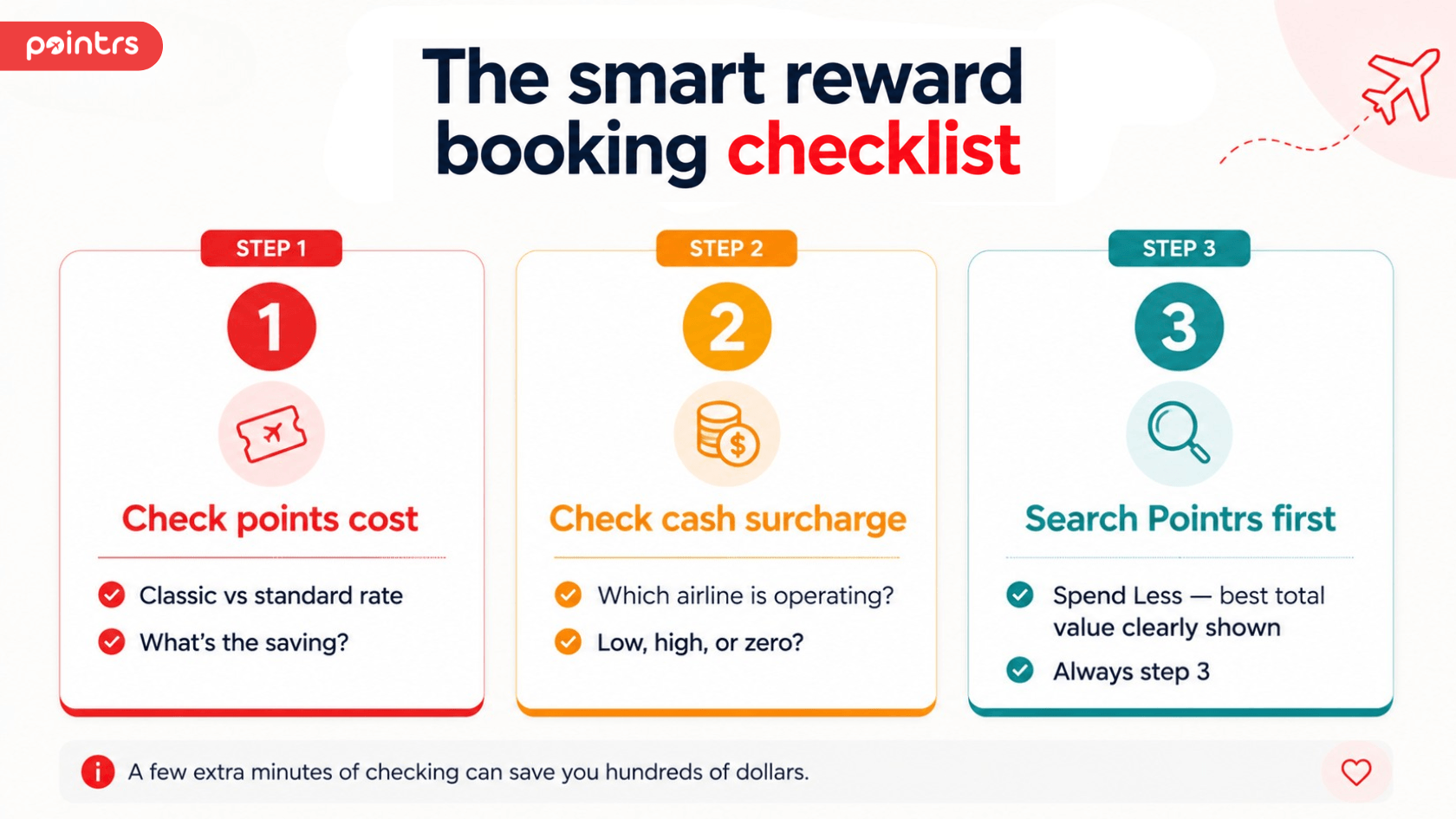
What smart redemptions look like in practice — live Pointrs
Here are four live Spend Less Pointrs available right now that illustrate what low-surcharge, high-value redemptions actually look like. Each of these has been selected because it delivers strong points savings while avoiding the heaviest surcharge traps.
Sydney to London — Economy Return — Save 370,000 points
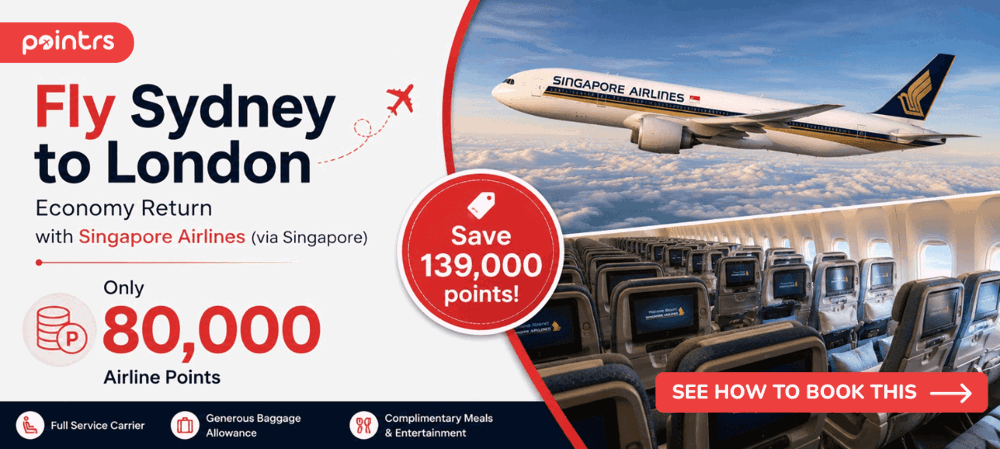
Sydney to London (LHR) Economy return via Singapore Airlines, bookable using KrisFlyer miles for just 80,000 miles — versus the standard 450,000 miles. Singapore Airlines charges no carrier surcharge on its own-operated flights. Total cash component: approximately $127, versus $1,296+ on the equivalent Qantas-operated Business Class redemption. This is a 370,000 mile saving, and the cash component is a fraction of what you'd pay on Qantas metal.
👉 See this Pointr: Sydney to London Economy Return — 80,000 KrisFlyer Miles
Perth to Rome — Economy Return — Save 230,000 points
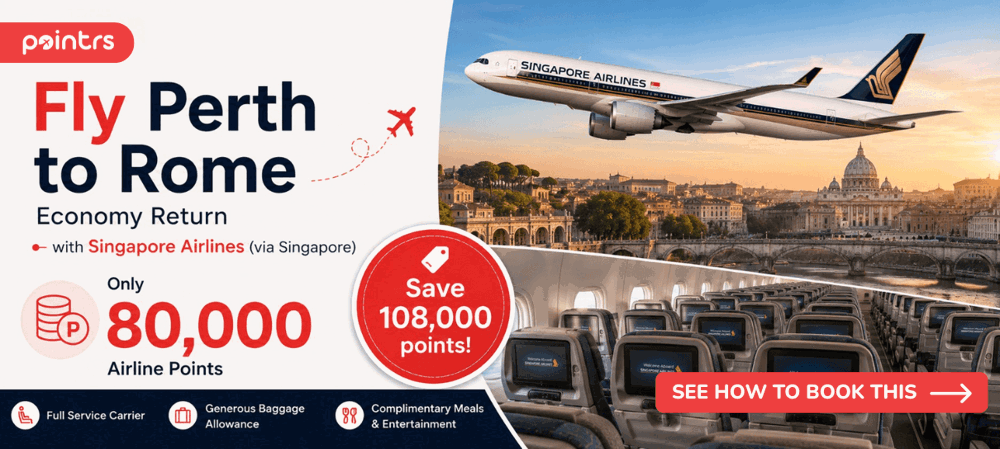
Perth to Rome Economy return via Singapore Airlines for just 80,000 KrisFlyer miles — saving 230,000 miles versus the standard 310,000 rate. Again, Singapore Airlines on own-operated metal means zero carrier surcharge. Perth's geography makes it one of the best Australian departure points for European travel via Singapore, with some of the shortest routing and flying times.
👉 See this Pointr: Perth to Rome Economy Return — 80,000 KrisFlyer Miles
Sydney to Paris — Business Class Return — Save 256,000 points
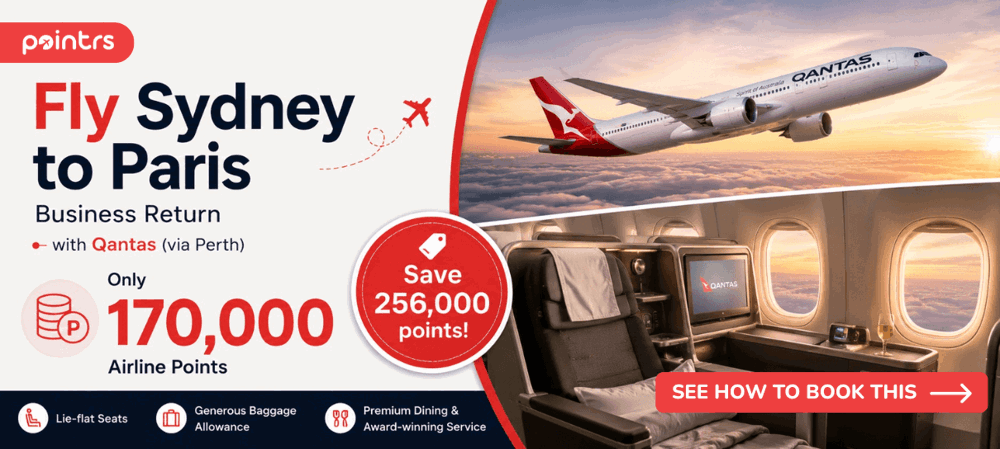
Sydney to Paris Business Class return on Qantas via Perth for 170,000 Qantas Points — saving 256,000 points versus the standard 426,000. The Qantas Perth routing avoids some of the heavier surcharge tiers that apply to direct European routing, and the Qantas Business Class product on the A380 and 787 remains one of the best available to Australians for long-haul travel.
👉 See this Pointr: Sydney to Paris Business Return — 170,000 Qantas Points
Brisbane to Tokyo — Business Class Return — Save 122,000 points
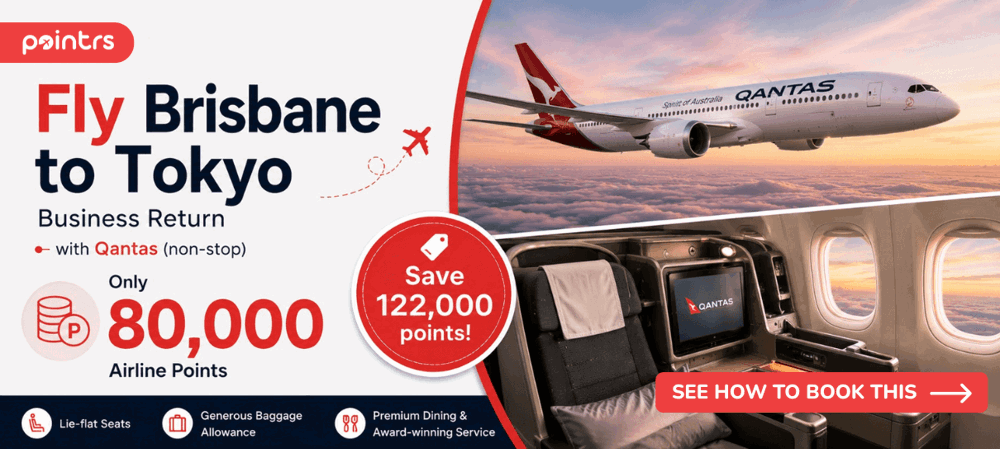
Brisbane to Tokyo (NRT) Business Class return on Qantas for 80,000 Qantas Points — saving 122,000 points versus the standard 202,000. Japan Airlines on this route carries modest carrier charges relative to European or US routes, and the JAL Business Class product is outstanding. Japan remains one of the best-value long-haul redemptions in the Qantas program.
👉 See this Pointr: Brisbane to Tokyo Business Return — 80,000 Qantas Points
The bottom line
Carrier surcharges are not a reason to stop playing the points game. They're a reason to play it more carefully.
The Australians who get genuinely extraordinary value from their Qantas Points and Velocity Points are not the ones with the biggest balances. They're the ones who know which redemptions carry heavy surcharges, which carriers avoid them entirely, and how to find the sweet spots where points savings and low cash costs align.
That knowledge is now yours. The tool that shows you every live redemption — points saving, program, and total value in one place — is Pointrs.
Want to go deeper? Read the full AU series
- Topic 1 — Why 3 in 5 Australians think frequent flyer points aren't worth it — and why they're wrong: The foundational case for why the game is absolutely worth playing — with real redemptions that prove it.
- Topic 2 — Qantas Points are being devalued — here's how to protect yourself before it's too late: What the August 2025 award chart changes, the Amex devaluation, and the RBA's October 2026 reform mean for your points — and what to do right now.
- Topic 4 — Why your everyday grocery and fuel spending is your fastest path to free flights in Australia: How to earn 100,000+ Qantas or Velocity Points per year from spending you were already going to do.
- Topic 5 — Qantas vs Velocity vs KrisFlyer: which program should you actually be using in 2026?: A no-fluff comparison of the three main programs available to Australians — and how to figure out which one fits your travel goals.
Carrier surcharge figures are based on published Qantas Frequent Flyer data effective August 2025 and Australian Frequent Flyer research published August 2025. Surcharge amounts are per return booking per adult and are subject to change. KrisFlyer surcharge figures sourced from pointhacks.com.au. All Pointrs reflect award redemptions available as of June 2026 and are updated regularly. Points requirements and award seat availability are subject to change. Taxes, fees and surcharges are payable in addition to points on all reward bookings. Always verify current costs before booking.