Quick Summary
Most Americans with Chase Ultimate Rewards, Amex Membership Rewards, or Capital One Miles make the same costly mistake: they book through the bank's travel portal because it's easy. The portal delivers a fixed value of 1–1.5 cents per point. But transferring those same points to an airline partner — on the same flight, on the same date — can deliver 2 to 5 cents per point, sometimes more. On a Business Class flight to Europe, that difference isn't marginal. It's the gap between spending 200,000 points and spending 60,000. This guide breaks down exactly how the portal vs transfer partner decision works, when each option wins, and shows you real redemptions available today through Pointrs — including New York to Athens Business Class return for 100,000 miles and Los Angeles to Tokyo Business Class return for just $1,699 via points.
Stop Redeeming Your Miles Through the Travel Portal — You're Getting Half the Value
You've been doing it wrong. And the worst part is — it looked like you were doing it right.
You open the Chase Travel portal. You search your flight. You see the points price. You book. Simple, clean, done.
But here's what happened: you just spent two to three times more points than you needed to. And you didn't even know it.
The value of your points can vary by up to 300% depending on how you redeem them. That is not a small difference. That is the gap between flying economy and flying Business Class. Between one trip and three. Between burning your entire balance on a single booking and having enough left over for another flight.
By transferring points to one of Chase's transfer partners, you can typically get 2 to 5 cents of value per point. The Chase Travel portal delivers a fixed 1.25 to 1.5 cents per point, depending on your card. Chase points are worth between 1 cent and 1.8 cents each depending on how they're used — and the ceiling only comes from transfer partners, not the portal.
This is the single most expensive mistake US points holders make. Not because it's hard to fix. Because it's invisible.
The portal looks like the easy win. It is, in fact, the expensive shortcut.
This article is going to show you exactly what you're losing, exactly when the portal actually makes sense, and exactly what those same points can buy when redirected to the right transfer partner. With live Pointrs, real savings figures, and no ambiguity.
What is the difference between a travel portal and transfer partners?
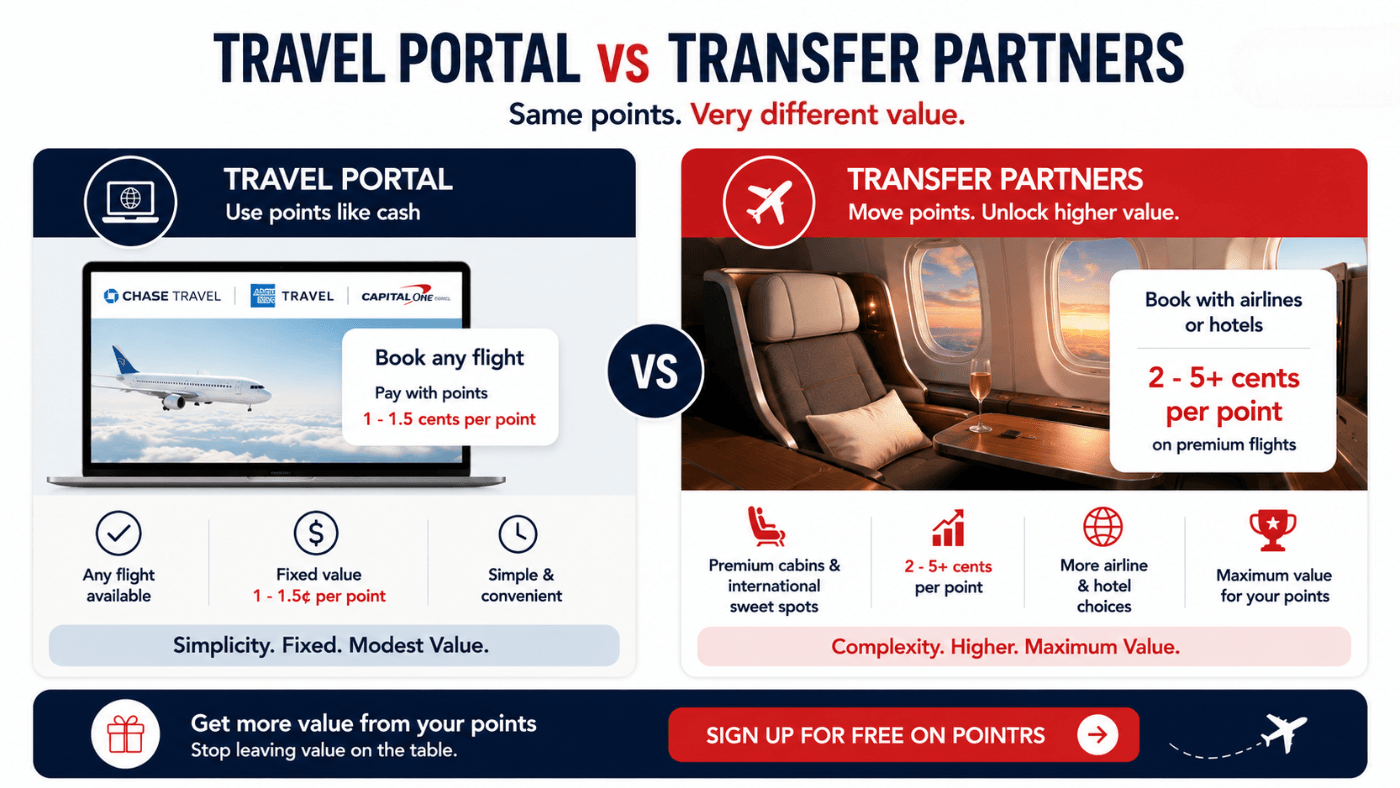
A travel portal (Chase Travel, Amex Travel, Capital One Travel) lets you use points like cash to book any available flight at a fixed value of 1–1.5 cents per point. A transfer partner is an airline or hotel loyalty program you can move your points into — usually at 1:1 — and then book directly using award pricing, which can deliver 2–5+ cents per point on premium cabin international flights. The key difference: the portal gives you simplicity and a fixed, modest value. Transfer partners give you complexity and dramatically higher value — particularly for Business Class, First Class, and long-haul international routes.
The Math That Changes Everything
Let's make this concrete before we go any further.
You have 100,000 Chase Ultimate Rewards points. You want to fly from New York to London in Business Class, return.
Option 1: Chase Travel portal
At 1.25–1.5 cents per point, 100,000 points = $1,250–$1,500 in travel credit. A Business Class return to London costs $4,000–$6,000 in cash. So 100,000 points covers roughly 25% of the ticket. You're still paying $2,500–$4,750 out of pocket.
Option 2: Transfer to an airline partner
Transfer those same 100,000 Chase points to United MileagePlus, Air Canada Aeroplan, or Virgin Atlantic Flying Club and you can book New York to London Business Class return for 60,000–90,000 miles — the entire ticket, not 25% of it.
By transferring to the right partner, you can save tens of thousands of points — enough for another free international flight — and increase your point value by 40% or more.
That's the same 100,000 points. The same flight. A completely different outcome.
And this isn't a rare edge case. International business class is where transfer partners shine brightest — routes that would cost 60,000+ points in a portal can sometimes be booked for 30,000–40,000 miles through the right airline partner.
Why Does the Portal Feel Like the Right Answer?
Because it's designed to.
Banks love the portal. When you book through Chase Travel or Amex Travel, the bank earns a commission on the booking — just like any online travel agency. The portal also keeps your points locked inside the bank's ecosystem, where they never reach their full potential.
TPG analysis found that flights booked through Chase's portal average 6% higher than booking directly — meaning you're often paying more points for slightly worse prices, before you even factor in the per-point value gap.
The portal is convenient. It requires no research, no transfer decisions, no award seat hunting. You just pay and book. But that convenience has a price — and it comes directly out of your points balance.
When the Portal Actually Wins
This is not a "never use the portal" guide. There are genuine situations where the portal is the smarter choice, and honesty here matters.
Short domestic flights and cheap economy fares. For short domestic flights, you're often better off booking through your credit card portal or using cash. If a domestic economy flight costs $150 in cash and the portal prices it at 10,000 points, that's 1.5 cents per point — acceptable value for a low-stakes, low-complexity booking. Hunting for a transfer partner sweet spot on a Chicago to Denver economy ticket rarely makes sense.
Chase's Points Boost feature. Chase introduced Points Boost in June 2025, which increases select bookings to 1.5–2 cents per point. For bookings that qualify for Points Boost, the portal can edge closer to transfer partner value on certain economy and domestic routes — worth checking before you transfer.
When award space isn't available. Transfer partners require available award seats, which can be limited — especially close to departure or on popular routes. The portal is especially useful when award seats aren't available or when fares are inexpensive. If you've searched the partner programs and found nothing, the portal is a legitimate backup.
The rule of thumb that matters: A small difference in value — like 1 cent per point in the portal versus 1.2 cents through a partner — usually isn't worth the extra complexity. But when you're looking at 1 cent versus 2 cents or more, the transfer is almost always worth it.
For Business Class or First Class on international routes: always check the transfer partners first. The value gap is too large to ignore.
The Critical Step Almost Everyone Skips
Here's the process that separates people who get 5 cents per point from people who get 1.5.
Before you transfer a single point, confirm the award seat exists.
Transfers are almost always irreversible. Once your Chase points become United miles, they stay United miles. If you transfer 60,000 Chase points to United MileagePlus hoping to book a Business Class seat to Tokyo — and that seat isn't available — you now have 60,000 United miles instead of 60,000 flexible Chase points. You've locked yourself in.
The right sequence is:
-
1. Find the flight you want (Google Flights, the airline's own website)
-
2. Go to the transfer partner's award search tool and confirm the seat is available at the award rate
-
3. Get all the way to the booking screen before touching your points
-
4. Then — and only then — transfer and book
Pointrs makes this process dramatically faster. Instead of checking every airline's award search tool independently, Pointrs surfaces the best available redemptions for your route across 40+ airlines and 100+ loyalty programs — with the savings clearly shown, the program identified, and the booking path mapped out.
What Transfer Partner Redemptions Actually Look Like
Here are live Pointrs available today — real redemptions that show exactly what happens when you move points out of the portal and into the right program.
New York to Athens — Business Class Return — Save 85,000 Miles
New York (JFK) to Athens (ATH) Business Class return via the right Star Alliance partner for just 100,000 miles — versus the standard 185,000 miles at full rate. That's a saving of 85,000 miles — or 46% off.

Through the Chase portal at 1.5 cents per point, 100,000 points buys you $1,500 of travel. A Business Class return to Athens in cash runs $3,500–$5,000+. The transfer path books the whole ticket for the same 100,000 points — delivering 3.5–5 cents per point in real value.
👉 See this Pointr: New York to Athens Business Return — 100,000 Miles
Los Angeles to Tokyo — Business Class Return — Save up to $5,001
Los Angeles (LAX) to Tokyo (NRT) Business Class return non-stop on United Airlines for just $1,699 via airline miles — versus a cash fare of up to $6,700. That's a saving of up to $5,001, or 75% off the cash price.
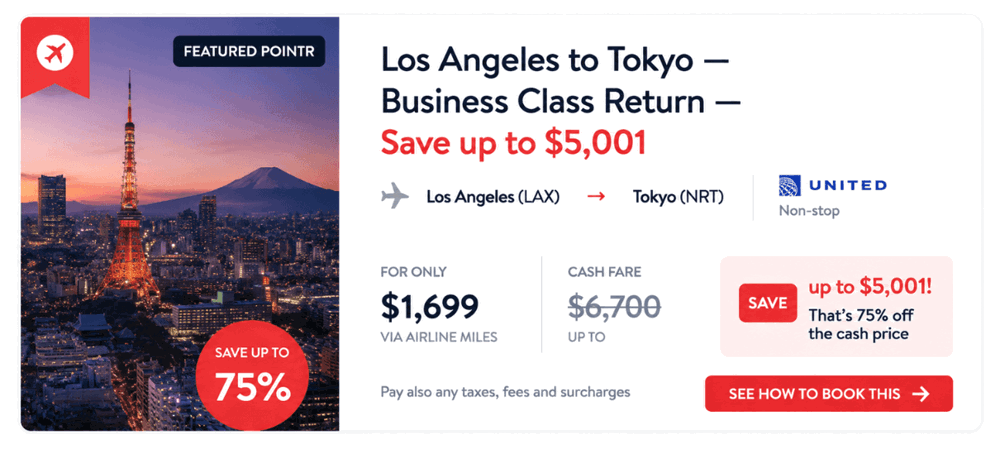
This is the kind of redemption the portal cannot touch. At 1.5 cents per point, getting $6,700 of Business Class value would cost you 446,000 points through the portal. The transfer path gets you there for a fraction of that — and the experience (lie-flat seats, United Polaris lounge access, priority boarding) is identical.
👉 See this Pointr: Los Angeles to Tokyo Business Return — from $1,699 via miles
New York to London — Business Class Return — Save 310,000 Miles
New York (JFK) to London (LHR) Business Class return for as few as 90,000 airline miles — versus the standard 400,000 miles. A saving of 310,000 miles, or 77% off.
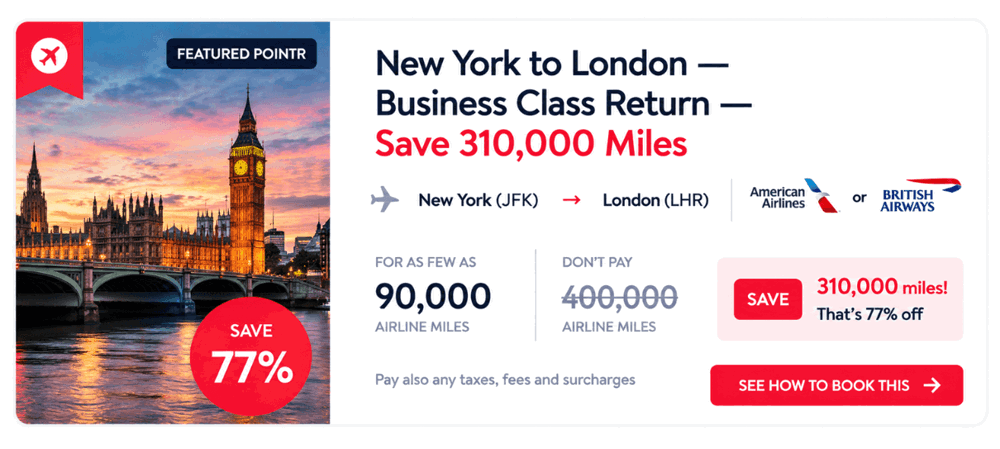
For a Chase cardholder with 90,000+ Ultimate Rewards points, this redemption — via the right transfer partner — is already within reach. Through the portal, 90,000 points delivers $1,125–$1,350 of travel credit. As a Business Class seat to London, those same points are worth $3,500–$5,500 in real flight value.
👉 See this Pointr: New York to London Business Return — from 90,000 Miles
San Francisco to Atlanta — Economy Return — Save 24,000 Miles
Transfer partners win on domestic routes too when the conditions are right. San Francisco (SFO) to Atlanta (ATL) Economy return on United Airlines for just 20,000 miles — versus the standard 44,000 miles. A saving of 24,000 miles, or 55% off.
At 20,000 miles, this is a route where checking the award chart before defaulting to the portal can deliver a meaningful saving — even on a domestic booking where portals are often competitive.
👉 See this Pointr: San Francisco to Atlanta Economy Return — 20,000 Miles
The Transfer Partner Map: Which Program Goes Where
Not every bank's points transfer to every airline. Here's the quick reference for the three most common flexible currencies held by Americans:
Chase Ultimate Rewards transfers to: United MileagePlus, Air France/KLM Flying Blue, British Airways Avios, Virgin Atlantic Flying Club, Air Canada Aeroplan, Singapore Airlines KrisFlyer, and more — 14 partners total, all at 1:1.
Amex Membership Rewards transfers to: Delta SkyMiles, British Airways Avios, Air France/KLM Flying Blue, Singapore Airlines KrisFlyer, ANA Mileage Club, Etihad Guest, and more — 19 airline partners, most at 1:1.
Capital One Miles transfers to: Turkish Airlines Miles&Smiles, Air Canada Aeroplan, British Airways Avios, Flying Blue, and others — 15+ partners, most at 1:1.
Chase, Amex, Citi, and Capital One periodically offer 15–30% transfer bonuses to specific partners. When a transfer bonus is running — say, a 30% bonus on Chase points to Flying Blue — the value gap versus the portal widens even further. A transfer that normally delivers 3 cents per point now delivers closer to 4 cents, while the portal stays fixed at 1.5.
Pointrs tracks these transfer bonus opportunities so you don't have to monitor them manually.
Check out all the latest and ongoing bonus promotions by logging into your dashboard, or sign up to our newsletter to receive bonus promotion alerts straight to your inbox. You can also visit our latest blog for a complete list of current promotions.
The Three Rules for Transfer Partner Decisions
Distilled from everything above, here's the framework for every miles redemption decision:
Rule 1: For international Business or First Class, always check transfer partners first. The value gap here — often 3x to 5x the portal rate — is too significant to skip. Even if it takes an extra 30 minutes of research, the point savings justify it every time.
Rule 2: Confirm availability before you transfer. Go to the airline's award search tool. Find the seat. Get to the booking screen. Then transfer. Never the other way around.
Rule 3: Use the portal for convenience on low-value bookings. Cheap domestic flights, last-minute economy seats where award availability is gone, or any booking where the per-point value difference is under 0.5 cents — these are the portal's natural home. Don't overthink them.
How Pointrs Makes This Decision Automatic
The hardest part of the transfer partner approach isn't the transfer itself. It's knowing which partner gives the best value for your specific route — and then confirming the seat exists before committing.
That research, done manually, can take hours. You'd need to check United MileagePlus, Aeroplan, Flying Blue, British Airways Avios, and Virgin Atlantic Flying Club for the same route, compare the award costs, factor in any fuel surcharges, and then verify availability on each one.
Pointrs does all of that for you.
With over 20,000 Pointrs across 40+ airlines and 100+ loyalty programs, Pointrs shows you the best available redemption for your route — the program, the cost in miles, the comparison against full rate, and the real saving — all in one place. Enter your balance, filter by what you can already afford, and see exactly which transfer unlocks your next trip.
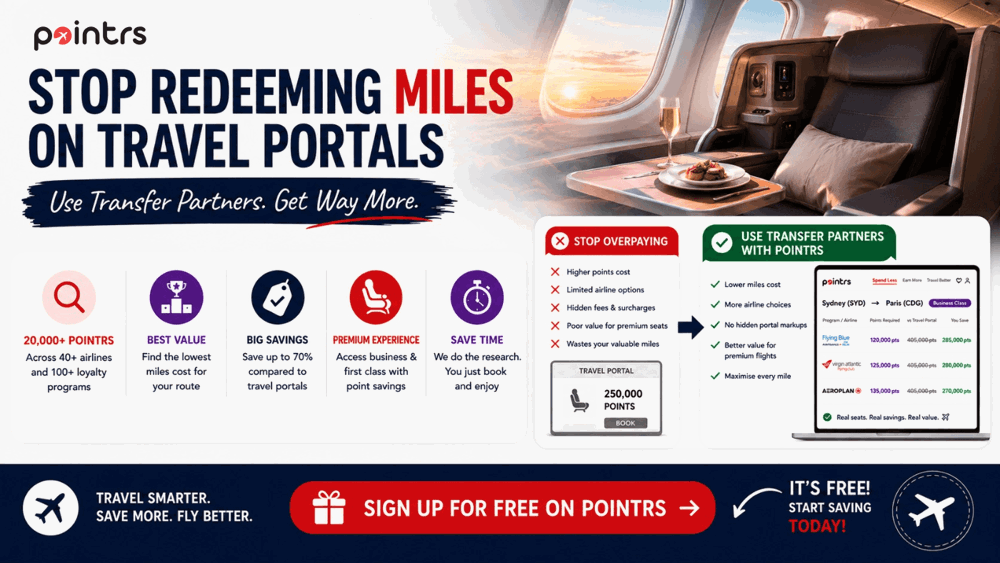
No forum-trawling. No spreadsheets. No guesswork.
👉 Browse all Spend Less Pointrs and see where your miles go furthest
👉 Set up your Pointrs dashboard and see what your current balance can already book
Want to Go Deeper? Read the Full US Series
This is the second in our series of guides for US travellers who are done leaving miles on the table. Each article tackles a specific pain point:
-
Topic 1 — You Have More Miles Than You Think — Here's Why You Still Can't Book That Free Flight: The five core reasons Americans can't convert their miles into flights — and how to fix each one.
The Bottom Line
Every time you book through the travel portal on a premium international route, you're leaving value on the table. Not a little value. Often 2–3 times the value of what you redeemed.
The miles game in the US isn't rigged against you. But it does reward the people who take one extra step — checking the transfer partners before hitting "book" in the portal. That single habit, applied consistently to international and premium cabin bookings, is worth tens of thousands of miles per year.
Pointrs is built to make that extra step effortless. So the right answer is always one search away — not an hour of research away.
👉 Browse all Spend Less Pointrs and find your best transfer partner redemption today
👉 Sign up to Pointrs and start getting full value from every mile you've earned
All Pointrs reflect award redemptions and cash savings available as of June 2026 and are updated regularly. Points transfer ratios, portal values, and award pricing are subject to change. Chase Ultimate Rewards transfer partners current as of June 2026 — always verify the current partner list and transfer ratio before initiating a transfer. Transfers between programmes are typically non-reversible. Always confirm award seat availability before transferring points. Taxes, fees, and carrier surcharges are payable in addition to miles.