Quick Summary
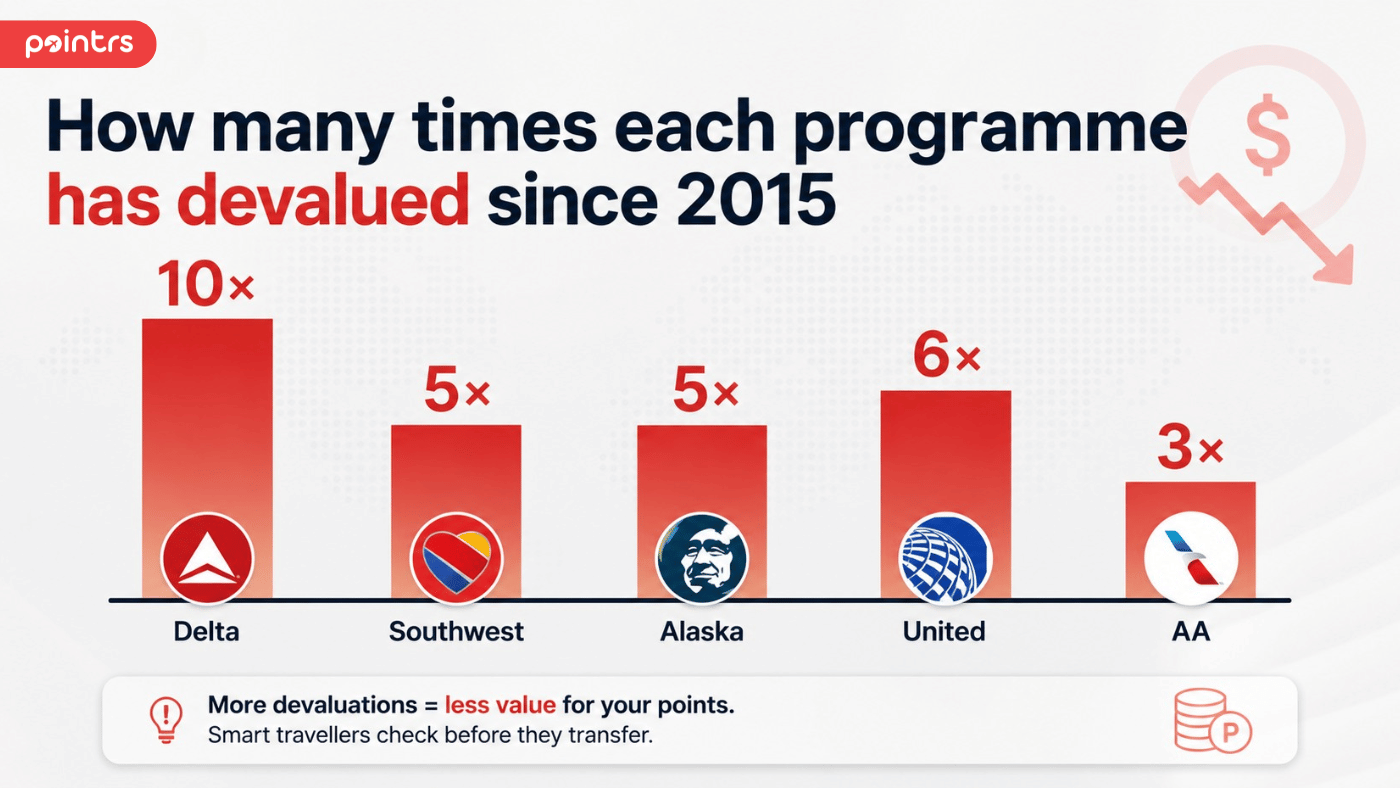
There are two separate threats to your miles balance in 2026 — and most Americans are only aware of one of them. The first is expiration: American AAdvantage miles expire after 24 months of account inactivity, and the programs of airline shutdowns like Spirit Airlines (May 2026) wiped balances to zero overnight. The second, and more insidious, is devaluation: Delta has devalued SkyMiles 10 times since 2015, United 6 times, and American 3 times. Dynamic pricing means award seats that cost 30,000 miles today could cost 50,000 for the same route next year. The US Department of Transportation opened a formal probe into these practices in 2024 — a clear signal the pressure is only growing. This guide tells you exactly which programmes are at expiry risk, what devaluation has already cost you, and the four specific actions to take right now to protect what you've built — with live Pointrs showing where the value still lives today.
The miles sitting in your account right now are not a fixed asset. They are a currency — and like any currency, they are subject to inflation, devaluation, and, in some cases, complete wipeout.
Most Americans think the threat to their miles is expiration. That is a real risk, but it is not the biggest one. Spirit Airlines ceased operations on May 2, 2026, leaving Free Spirit miles with no clear path to recovery — a total loss for members who had been accumulating balances for years. That is the extreme end of the risk spectrum. Far more likely, and far more silent, is the devaluation happening inside every programme you currently hold.
Dynamic pricing tends to devalue points, requiring higher balances for redemptions. In other words, your points aren't worth as much as they used to be. This is not a one-time event. It is an ongoing process that has been accelerating across all three major US airline programmes throughout 2024 and 2025.
The US Department of Transportation opened a probe into the rewards programmes at American Airlines, Delta Air Lines, Southwest Airlines, and United Airlines in 2024, citing concerns about reward devaluation, dynamic pricing, hidden fees, and reduced competition. When a federal regulator opens a formal inquiry into whether airlines are systematically devaluing loyalty currencies, that is a signal worth paying attention to.
This article is your action plan. Here is exactly what has happened to your miles, what is still at risk, and the four specific things to do right now to protect what you have earned.
Do airline miles expire, and how do I stop them losing value in 2026?
It depends entirely on the programme. United MileagePlus miles never expire as long as your account remains open (Travel Better Pointr #6802). Delta SkyMiles never expire (Pointr #6804). Alaska Atmos Rewards miles never expire (Pointr #6809). American AAdvantage miles expire after 24 months of account inactivity — any earning or redemption activity resets the 24-month clock (Pointr #6791). British Airways Club Avios expire after 36 months of inactivity (Pointr #6792). Air France Flying Blue miles expire after 24 months of inactivity (Pointr #6803). Avianca LifeMiles expire after just 12 months of inactivity (Pointr #6799). ANA Mileage Club miles are the most restrictive: they expire on a rolling 3-year basis from the date each mile was earned, regardless of any account activity (Pointr #6798). Singapore Airlines KrisFlyer miles expire 36 months after the date they were earned, not the date of last activity (Pointr #6801). To prevent expiry on inactivity-based programmes, make any qualifying activity — a small purchase through the airline's shopping portal, a miles transfer, a credit card spend that earns in that programme, or a hotel booking — before the inactivity deadline. Every programme has a dedicated Prevent Expiry Travel Better Pointr on Pointrs showing exactly what activity counts for each one.
The two threats — and why people confuse them
Expiration and devaluation are different problems requiring different responses. Most people conflate them, which leads to either unnecessary anxiety about programmes that have eliminated expiration, or dangerous complacency about the devaluation happening silently in every programme they hold.
Expiration: which programmes still have an inactivity clock
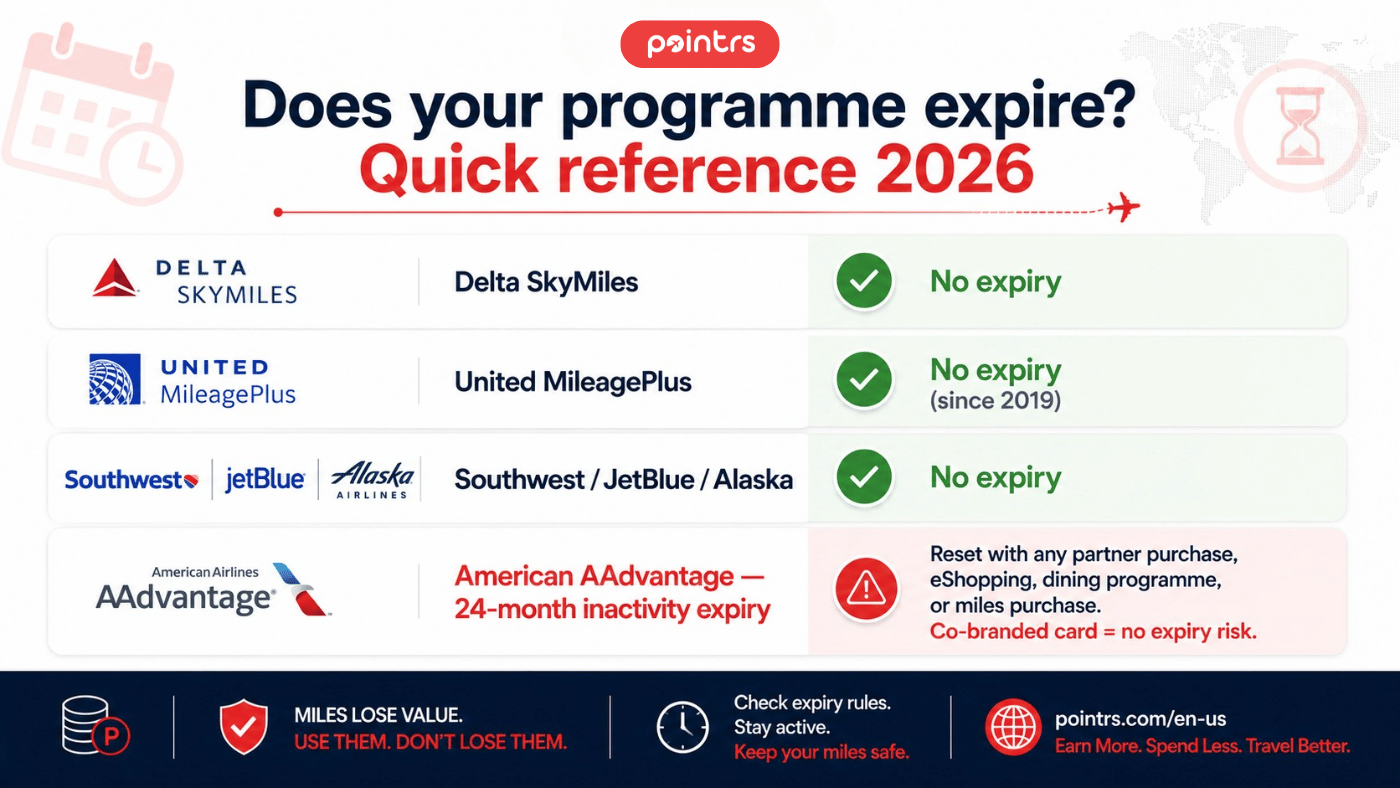
Four major US carriers — Delta, Southwest, JetBlue, and Alaska — have eliminated expiration entirely. Your miles in those programmes never expire, regardless of how long your account sits dormant. United eliminated its expiration policy in 2019. Your MileagePlus miles stay in your account as long as it remains open.
The one major holdout: American AAdvantage miles expire after 24 months of account inactivity. Activity is broadly defined — a single purchase through the AAdvantage eShopping portal, a dinner at an AAdvantage Dining restaurant, a partner hotel booking, or a miles purchase all reset the clock for another two years. Holding an AAdvantage co-branded credit card eliminates the expiration risk entirely, as card spending constitutes continuous activity.
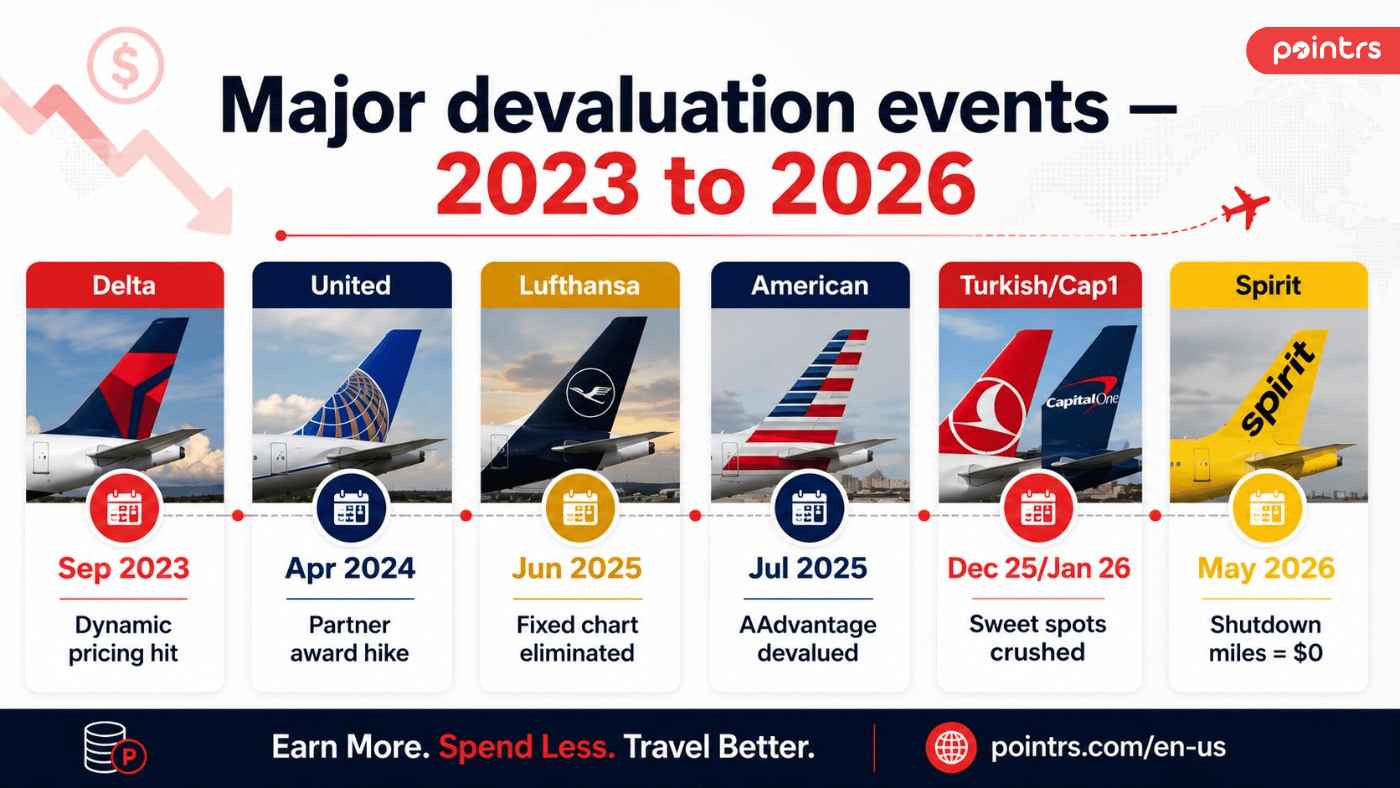
The catastrophic expiration risk, illustrated in stark terms in 2026: Spirit Airlines ceased operations on May 2, 2026. Free Spirit miles will likely lose all of their value, as they are nonredeemable and nontransferable. When an airline shuts down, its loyalty currency goes with it. This is not a theoretical risk — it happened to thousands of Americans who had been patiently earning Free Spirit miles.
THE SPIRIT AIRLINES LESSON
Spirit Airlines ceased operations on May 2, 2026. Every Free Spirit mile balance was wiped to zero. No transfer option. No conversion. No recovery through bankruptcy. This is the endpoint of hoarding miles in a financially distressed programme. If your balance is in a programme with financial uncertainty, act now.
Devaluation: the silent erosion happening in every programme
This is the bigger threat — and the more insidious one, because it happens without announcements or warning letters. Delta has devalued SkyMiles 10 times since 2015, United MileagePlus 6 times, American AAdvantage 3 times, and Southwest Rapid Rewards 5 times. These are not rounding errors or minor adjustments. Each devaluation means your existing balance buys less than it did before.
The mechanism: across major US airline loyalty programmes, the trend is that miles are becoming more closely tied to spending, credit card use, fare type, and demand. Travellers who once saved a predictable number of miles for a trip may now find the same route costs far more points during peak travel periods.
2025 was particularly severe for the broader global landscape. Lufthansa Miles and More moved Lufthansa Group-operated awards away from a fixed chart to variable mileage amounts effective June 3, 2025. Turkish Miles and Smiles crushed its domestic and Hawaii sweet spots in December 2025. Capital One devalued its Emirates transfers from 1:1 to 1,000:750 effective January 2026. Every one of these changes reduced what existing balances could buy — with little or no warning.
The four actions to take right now
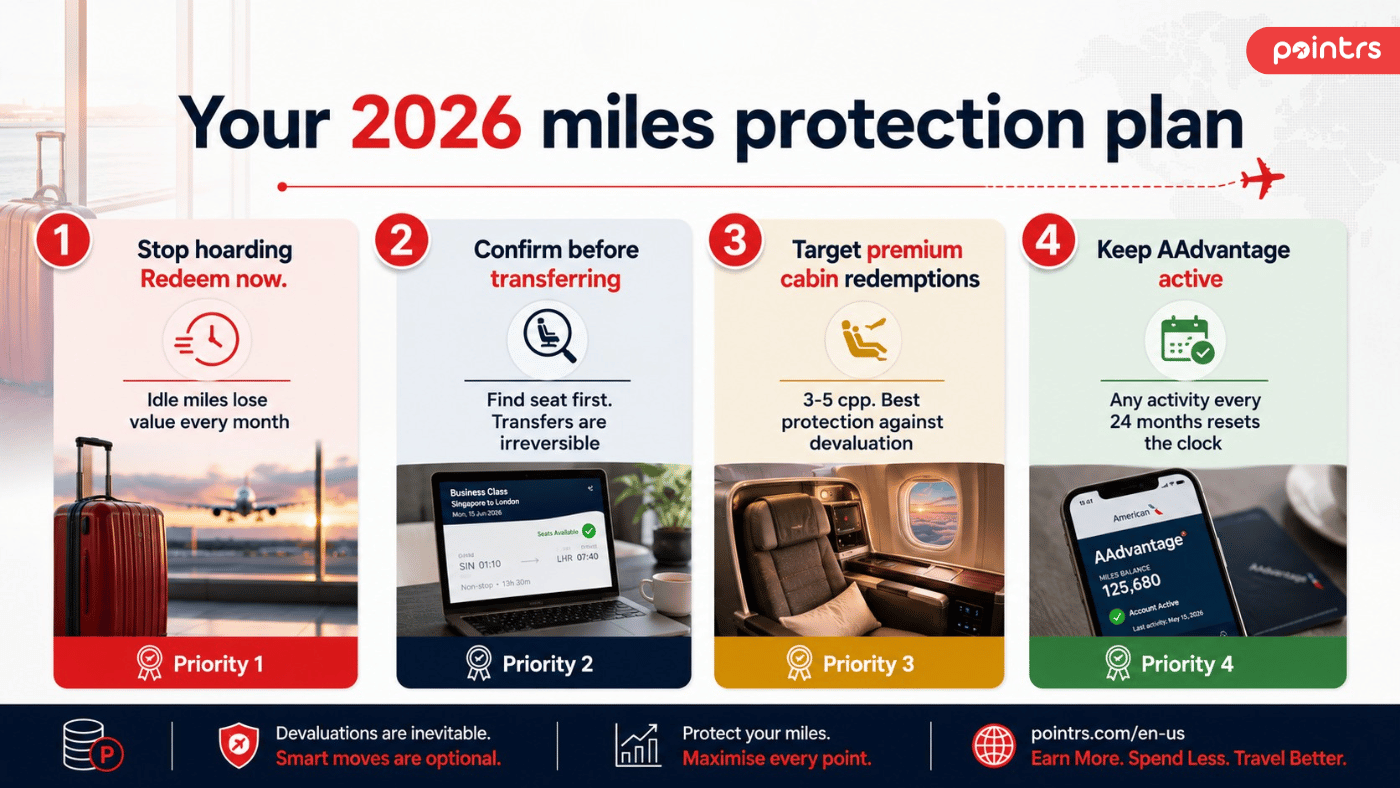
Understanding the threat is useful. Knowing what to do about it is what matters. Here are four specific actions — in priority order — for every American with a miles balance in 2026.
Action 1: Stop hoarding — prioritise redeeming over accumulating
The single most important mindset shift: miles are not a savings account. They are a depreciating asset. Every month you hold a balance without redeeming is a month where the purchasing power of that balance can decrease — through dynamic repricing, programme changes, or the slow drift of inflation in award costs.
The clearest lesson from 2025: if you are sitting on a balance for someday, you are volunteering for the next devaluation. "Someday" is the most expensive word in the points game.
This does not mean burning miles carelessly on low-value redemptions. It means identifying your target trip, confirming a high-value redemption path through Pointrs, and booking it — rather than continuing to accumulate toward a target that keeps moving further away as programmes reprice.
Action 2: Confirm award availability before you transfer
With more native-programme-only inventory and more dynamic pricing, speculative transfers are riskier than ever. The fundamental rule for all transfer-partner redemptions has not changed: find the seat, confirm it is available at the award price, get to the booking screen — then transfer.
Never transfer points to an airline programme speculatively. The transfer is almost always irreversible. If you move 80,000 Chase points to United MileagePlus hoping to find a Tokyo Business Class seat and the seat is not there, you now have 80,000 United miles instead of 80,000 flexible Chase points. You have locked yourself out of every other use of that currency.
Pointrs surfaces available redemptions in real time — showing you the programme, the award cost, and the saving versus standard rate — so you are not searching blind before committing to a transfer.
Action 3: Prioritise high-value redemptions over low-value ones
Not all redemptions erode equally in a devaluation environment. Cash-equivalent redemptions (statement credits, merchandise, gift cards) are already low-value and get proportionally worse as programmes reduce the per-point rate on these options. They are also the first category to be cut in devaluation events.
International Business and First Class redemptions via transfer partners deliver 3–5 cents per point — and while devaluations have increased the mile cost of some routes, the best sweet spots still deliver extraordinary value relative to cash fares. The gap between what you can extract through a smart redemption and what you would get from a portal booking or cash-equivalent redemption is still enormous.
The strategic move: if you have a balance that can reach a high-value redemption right now, book it. Do not wait for the balance to grow while the redemption cost increases.
Action 4: Keep AAdvantage active if you hold a balance there
American AAdvantage remains the only major US programme with an active expiration policy. Any qualifying activity resets the clock for another 24 months — and the bar for qualifying activity is low. An AAdvantage eShopping purchase. A dinner at a partner restaurant. A small miles purchase. Any of these extends your balance's life by two full years.
If you hold a significant AAdvantage balance and do not fly American regularly, set a calendar reminder every 18 months to trigger one qualifying activity. It takes five minutes and protects years of accumulated miles.
Where the value still lives — live Pointrs to book right now
Devaluation has not eliminated value from the system. It has concentrated it. The routes and programmes that have not yet been hit by dynamic pricing or award chart hikes still offer outstanding redemptions — and in several cases, the value is better than anything that existed two years ago because the cash fare has increased faster than the award price.
Here are four live Pointrs that show exactly where the value is right now.
New York to London — Business Class return — save 310,000 miles
New York (JFK) to London (LHR) Business Class return from just 90,000 miles — saving 310,000 miles against the standard 400,000 rate. A 77% saving. Via Chase Ultimate Rewards transferred to the right Star Alliance programme, this redemption has not been eliminated by the devaluation wave. It still exists. It still represents one of the most powerful uses of a transferable points balance.

Los Angeles to Tokyo — Business Class return — save up to $5,001
Los Angeles (LAX) to Tokyo (NRT) Business Class return on United for $1,699 via airline miles — versus a cash fare of up to $6,700. A saving of up to $5,001, or 75%. United MileagePlus's fixed Star Alliance partner pricing has been a relative safe haven from dynamic devaluation for partner awards, and this Japan routing remains one of the best-value premium cabin redemptions available from the West Coast.

New York to Athens — Business Class return — save 85,000 miles
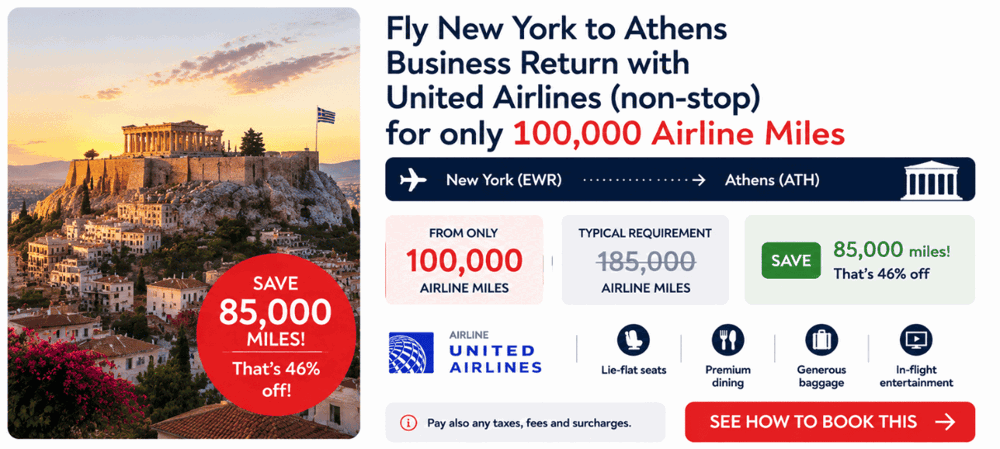
New York (JFK) to Athens (ATH) Business Class return for 100,000 miles — saving 85,000 miles against the standard 185,000. A 46% saving. Mediterranean Europe via Star Alliance remains one of the most accessible premium cabin redemption corridors from the US East Coast, and this route has not been subject to the same devaluation pressure as some of the more heavily-trafficked transatlantic routes.
Chicago to Cancun — Economy return — save 40,000 miles
Chicago (ORD) to Cancun (CUN) Economy return on United for just 20,000 miles — saving 40,000 miles against the standard 60,000 rate. A 66% saving. Not every redemption needs to be transatlantic Business Class. For the traveller with a modest balance looking to extract value before the next programme adjustment, a clean leisure-route saving like this is exactly what Pointrs is built to surface.

How Pointrs keeps you ahead of devaluation
The hardest part of managing miles in a devaluation environment is not knowing when the next change is coming. You cannot predict when United will reprice its Star Alliance partner awards or when American will adjust its AAdvantage chart. What you can control is how quickly you act when you have a high-value redemption within reach.
Pointrs tracks over 20,000 redemptions across 40+ airlines and 100+ loyalty programmes — updated regularly to reflect current award pricing, not the pricing from six months ago. Enter your balance, filter by what you can already afford, and see exactly which of those redemptions are available right now. The goal is not to panic about devaluation — it is to act with clarity when the right redemption is in front of you.
The miles you have earned have real value. The people who protect that value are not the ones who track every programme change obsessively. They are the ones who know which redemptions represent the best available value at any given moment — and book them before that moment passes.
US Frequent Flyer Guide — Full Series
- Topic 1 — You have more miles than you think — here's why you still can't book that free flight
- Topic 2 — Stop redeeming your miles through the travel portal — you're getting half the value
- Topic 3 — Credit card points fatigue is real — here's how to simplify without losing the value
- Topic 4 — You're loyal to the wrong airline — here's how to figure out which miles programme is right for you
Earn More. Spend Less. Travel Better. — Devaluation counts sourced from Miles Earn and Burn, September 2025. Expiry policies sourced from Points to Pictures, May 2026, The Miles Market, February 2026, and Autopilot Travel, May 2026. Spirit Airlines shutdown confirmed May 2, 2026 via US News and AwardWallet. DOT probe into airline loyalty programmes confirmed via Yahoo Finance, April 2026 and Moneywise, May 2026. 2025 global devaluation timeline sourced from The Miles Market, February 2026. All Pointrs reflect award redemptions available as of July 2026 and are updated regularly. Points and miles requirements, cash fare comparisons, and award seat availability are subject to change. Taxes, fees, and carrier surcharges are payable in addition to miles. Always verify current programme policies before making award bookings or point transfers.