Quick Summary
The best credit card for airline miles in the US in July 2026 depends almost entirely on two things: your annual fee tolerance and your spending patterns. For beginners and most everyday travellers, the Chase Sapphire Preferred is the strongest starting point — 100,000 bonus points after $5,000 spend in three months (tied for its biggest-ever offer, ending today), a $95 annual fee, and access to 14+ transfer partners including United, British Airways, and Singapore Airlines. For dining and grocery heavy spenders, the Amex Gold at $325 earns 4x at restaurants and US supermarkets and feeds into the powerful Amex Membership Rewards transfer network. For premium travellers who want lounge access and a manageable effective fee, the Capital One Venture X at $395 earns 2x on everything and transfers to 15+ partners. For luxury travel and maximum credits, the Amex Platinum at $895 delivers 5x on flights booked directly and the widest lounge access network. This guide tells you exactly which card wins for which type of spender — and what each bonus can actually buy when redeemed through Pointrs.
Here is the most common credit card mistake in the US travel rewards space: people choose a card based on the airline they most recently flew, or the bank whose branch they pass on the way to work, and then spend years earning points in a programme that doesn't align with how they actually travel.
The best travel credit cards combine solid earn rates, valuable points, and flexible redemption into a card worth holding long-term. But "best" is not a universal answer. The card that delivers maximum value for a frequent business traveller flying United out of Chicago is categorically different from the card that works best for a family spending heavily on groceries and restaurants in the suburbs of Atlanta.
This guide cuts through the noise. Here is the honest, current picture of every major US travel card category — the exact earn rates, the current bonuses, the annual fees, the transfer partners, and the type of spender each card genuinely suits. No commission-driven rankings. Just the clearest picture of which card is right for your specific situation.
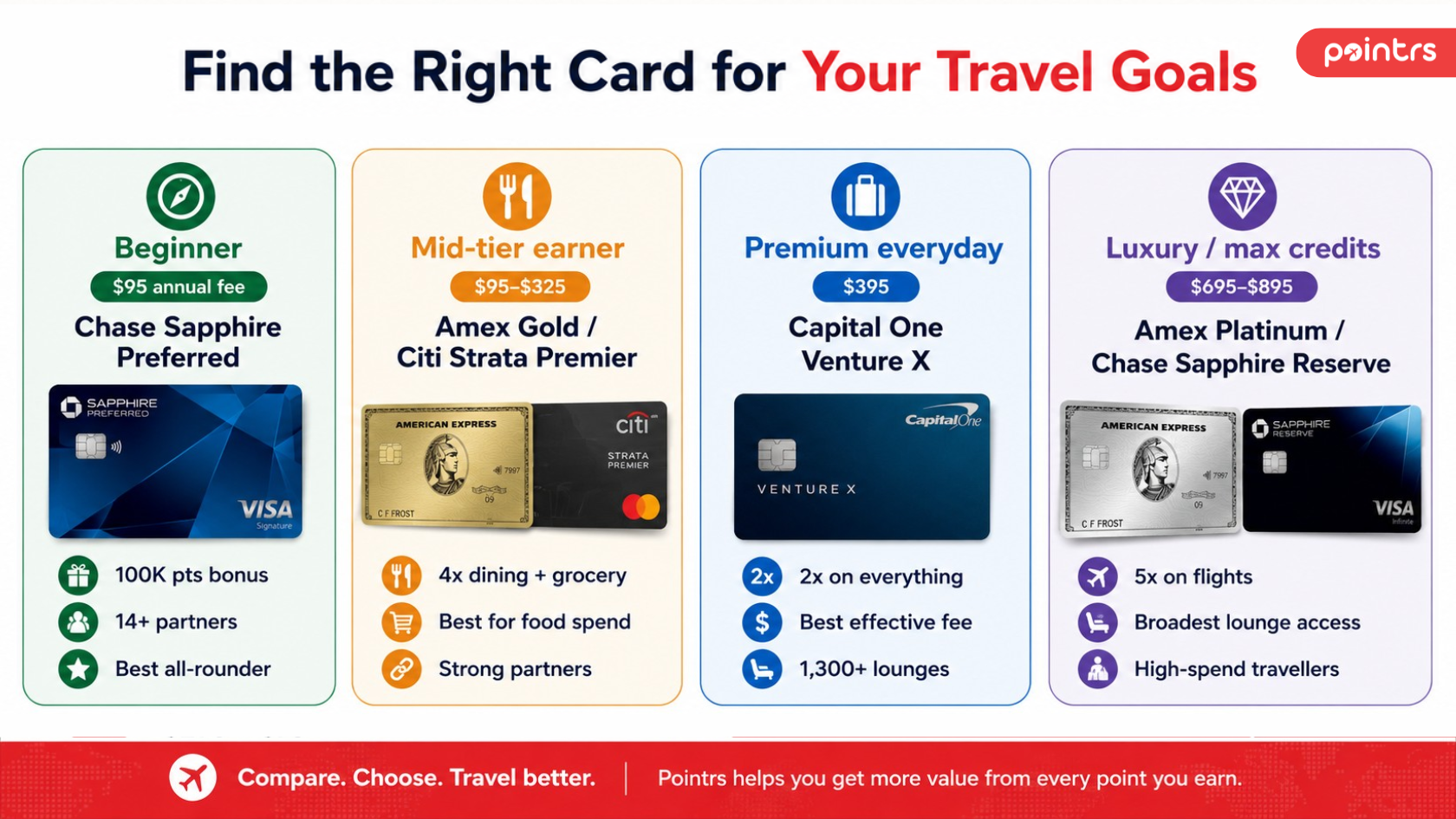
What is the best credit card for airline miles in the US in 2026?
The best credit card for airline miles in the US in 2026 depends on your annual fee comfort and spending patterns. For most people starting out, the Chase Sapphire Preferred ($95/year) is the strongest all-round option — 100,000 bonus points, 3x on dining, travel, gas, streaming, and vacation rentals, plus 14+ transfer partners at 1:1. For heavy dining and grocery spenders, the Amex Gold ($325/year) earns 4x at restaurants worldwide and US supermarkets, feeding into Amex Membership Rewards' 19 transfer partners. For simplicity with premium perks, the Capital One Venture X ($395/year) earns a flat 2x on everything, transfers to 15+ partners, and delivers a $300 Capital One Travel credit plus Priority Pass lounge access that offsets the fee. For maximum flight earning and lounge access, the Amex Platinum ($895/year) earns 5x on flights booked directly and delivers the widest suite of premium travel benefits. For co-branded airline cards, choose the card for the airline whose hub is closest to where you live — United Explorer for United hub cities, Delta Gold Amex for Atlanta, Charlotte and Detroit, Citi Strata Elite for American hub cities.
How to choose before comparing individual cards
Before looking at any specific card, the most important question is not "which card has the best bonus?" It is: what do I spend most on, and how do I want to redeem?
If you spend most of your money on flights and hotels, a travel-category-heavy card like the Chase Sapphire Reserve or Amex Platinum makes sense. If your biggest monthly spend is restaurants and groceries, the Amex Gold or Citi Strata Premier will out-earn those cards on everyday spending despite lower travel category multipliers. If you want simplicity above all — one card, no category management, consistent earning on everything — the Capital One Venture X's flat 2x rate is nearly impossible to beat at its fee level.
The second question: flexible points or airline-specific miles? Capital One miles can be transferred to more than 15 airline and hotel partners. Based on TPG's May 2026 valuations, Capital One miles are worth 1.85 cents each. Chase Ultimate Rewards points are worth 2.05 cents apiece, according to TPG's May 2026 valuations. Both are transferable currencies — meaning you keep your options open until you know exactly which programme gives the best award for your trip. Co-branded airline cards (United Explorer, Delta Gold, Citi Strata Elite) earn airline-specific miles with less flexibility but often include card-specific benefits — free checked bags, priority boarding, and companion certificates — that add real value for loyal flyers.
The best card for most people — Chase Sapphire Preferred
Chase Sapphire Preferred — Chase Ultimate Rewards, 14+ transfer partners at 1:1
- Sign-up bonus: 100,000 points after $5,000 spend in 3 months (limited-time, ended July 30 2026)
- Annual fee: $95
- Earn rates: 3x dining, travel, gas/EV, streaming, vacation rentals (Airbnb/Vrbo); 1x everything else
- Key transfer partners: United MileagePlus, British Airways Avios, Air Canada Aeroplan, Singapore Airlines KrisFlyer, Virgin Atlantic Flying Club, Hyatt (4:3 ratio from fall 2026)
The most consistently recommended starting travel card in the US. Until July 30 2026, new applicants can earn 100,000 Chase Ultimate Rewards points after spending $5,000 in the first 3 months — the card's biggest-ever offer, and a big step above its standard 75,000-point welcome offer.
New for 2026: the card now earns 3x on gas and EV charging, 3x on vacation rentals, adds a $120 Global Entry/TSA PreCheck credit, and has doubled its Chase Travel hotel credit to $100 — with the $95 annual fee unchanged.
At TPG's 2.05¢ valuation, that 100,000-point bonus is worth $2,050+ when transferred to a partner programme. This is the card that feeds into nearly every premium redemption covered in the Pointrs US blog series.
Note: starting in fall 2026, World of Hyatt transfers will move to a reduced 4:3 ratio — factor this in if Hyatt is your primary redemption target.
The best card for dining and grocery spenders — Amex Gold
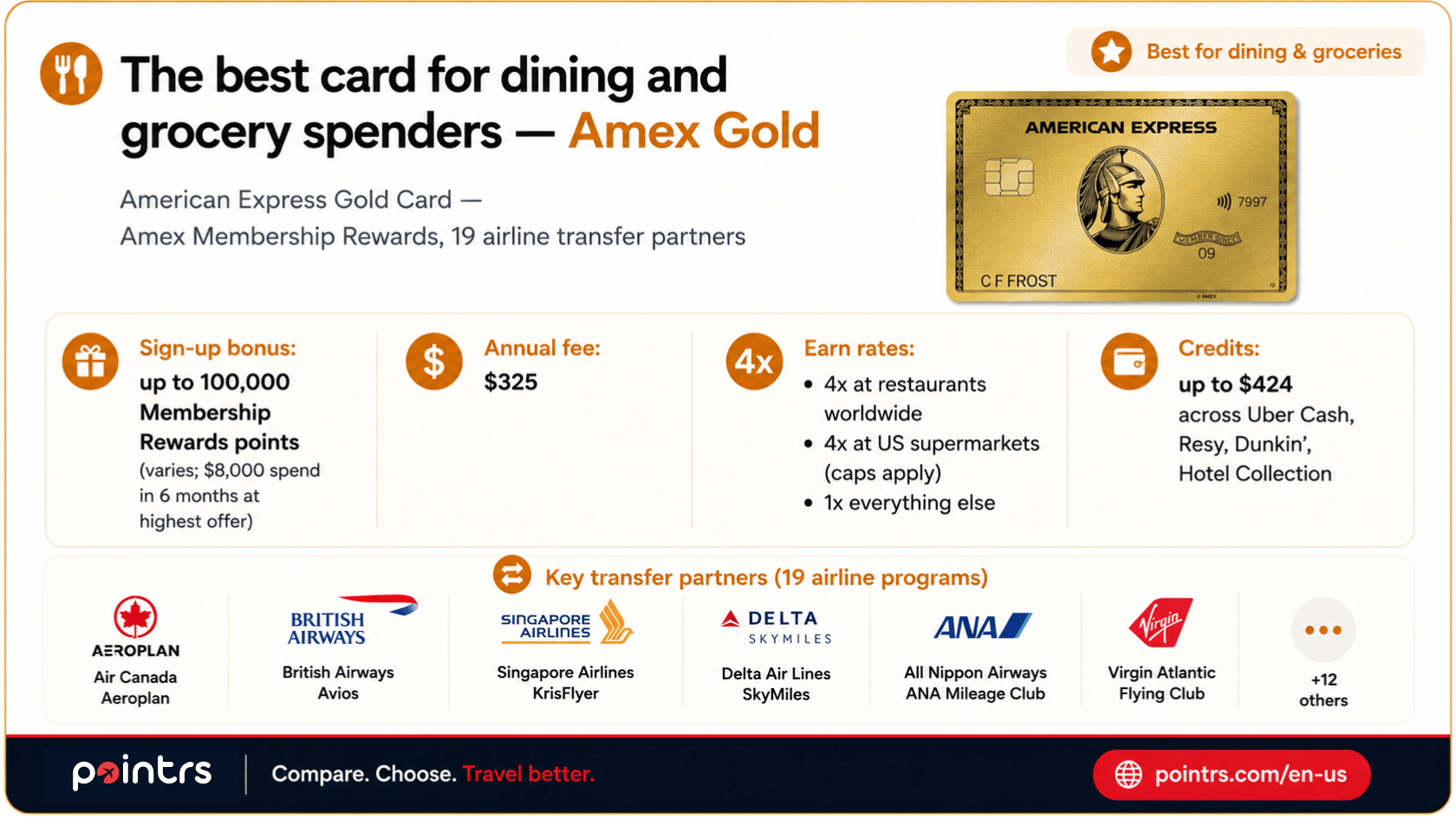
American Express Gold Card — Amex Membership Rewards, 19 airline transfer partners
- Sign-up bonus: up to 100,000 Membership Rewards points (varies; $8,000 spend in 6 months at highest offer)
- Annual fee: $325
- Earn rates: 4x at restaurants worldwide; 4x at US supermarkets (caps apply); 1x everything else
- Credits: up to $424 across Uber Cash, Resy, Dunkin', Hotel Collection
The Amex Gold earns 4x Membership Rewards points at U.S. supermarkets and up to 4x at restaurants worldwide — both with annual spend caps. For a household spending $800/month on groceries and $600/month on dining, that's approximately 201,600 Amex MR points per year from two categories alone.
The card offers $424 in annual credits across Uber Cash, Resy dining, Dunkin', and The Hotel Collection — making the effective annual fee closer to $0–$100 for cardholders who use them. The 19 Amex Membership Rewards transfer partners include Delta SkyMiles, Air France Flying Blue, British Airways Avios, ANA Mileage Club, Singapore Airlines KrisFlyer, and more. Needs a catch-all companion card (Venture X, Freedom Unlimited, or Blue Business Cash) for non-bonus spend.
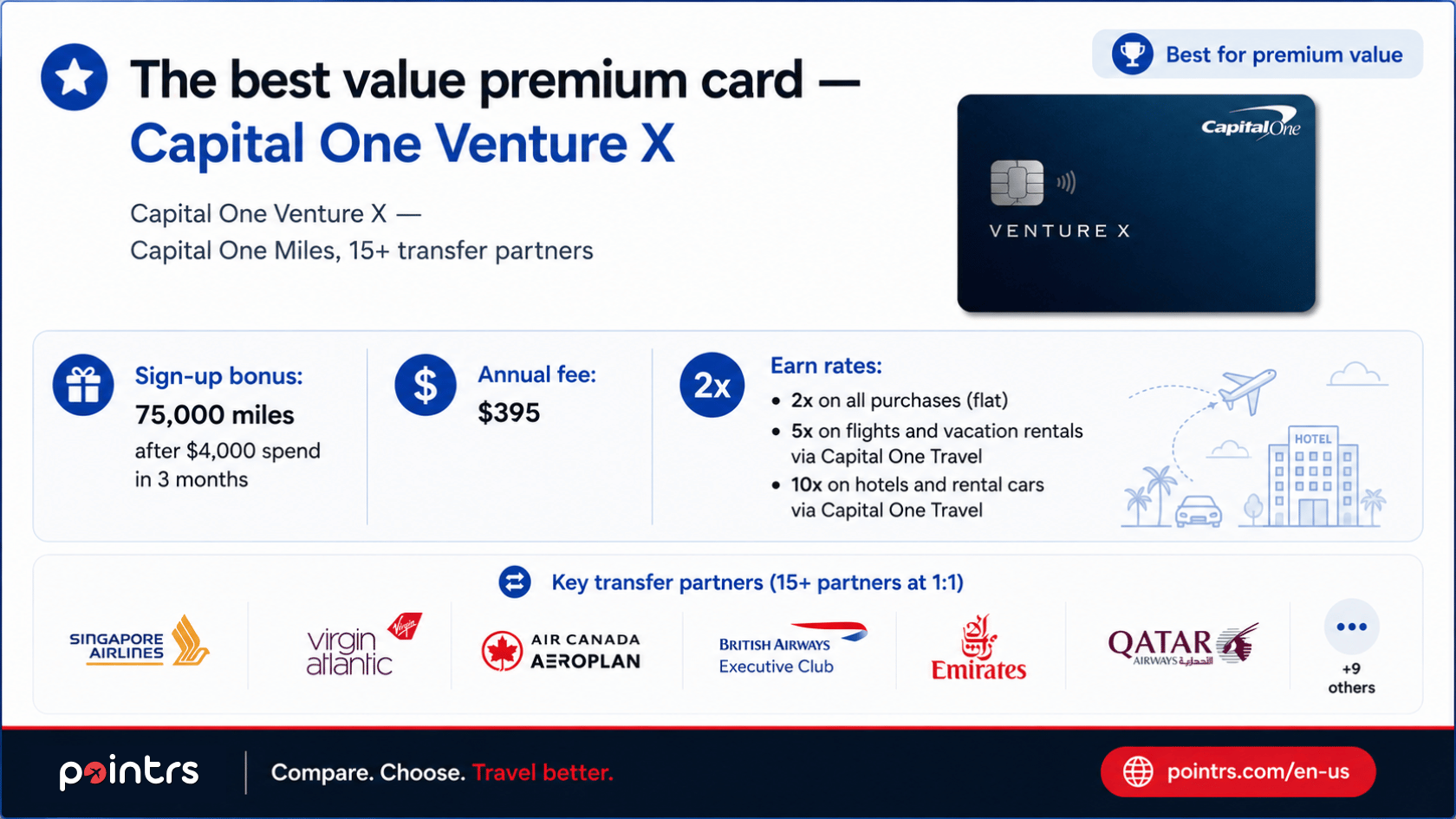
The best value premium card — Capital One Venture X
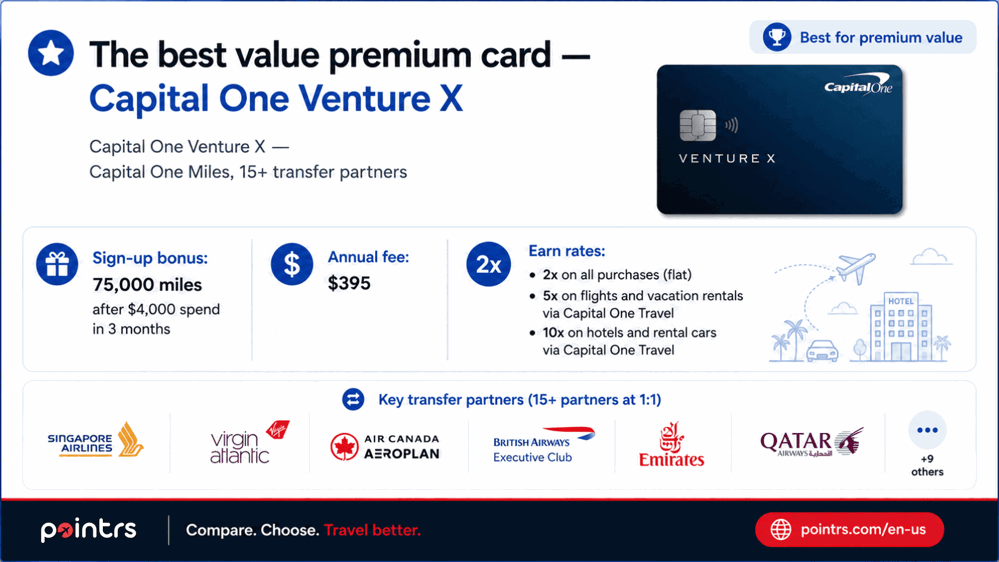
Capital One Venture X — Capital One Miles, 15+ transfer partners
- Sign-up bonus: 75,000 miles after $4,000 spend in 3 months
- Annual fee: $395
- Earn rates: 2x on all purchases (flat); 5x on flights and vacation rentals via Capital One Travel; 10x on hotels and rental cars via Capital One Travel
The Capital One Venture X at $395 undercuts the Amex Platinum and Chase Sapphire Reserve by a wide margin, while delivering a flat 2x miles rate on absolutely everything — one of the best flat rates on any card. The $300 annual Capital One Travel credit and 10,000 anniversary miles (worth $100) together create an effective annual fee of negative $5 for regular travellers. The card includes access to 1,300+ lounges worldwide — Capital One Lounges, Priority Pass, and Plaza Premium — after enrollment.
Transfer partners include Turkish Airlines Miles and Smiles, Air Canada Aeroplan, British Airways Avios, and Air France Flying Blue. The Venture X is the simplest path to a premium travel card without category management complexity.
The best card for high-frequency flyers — Amex Platinum
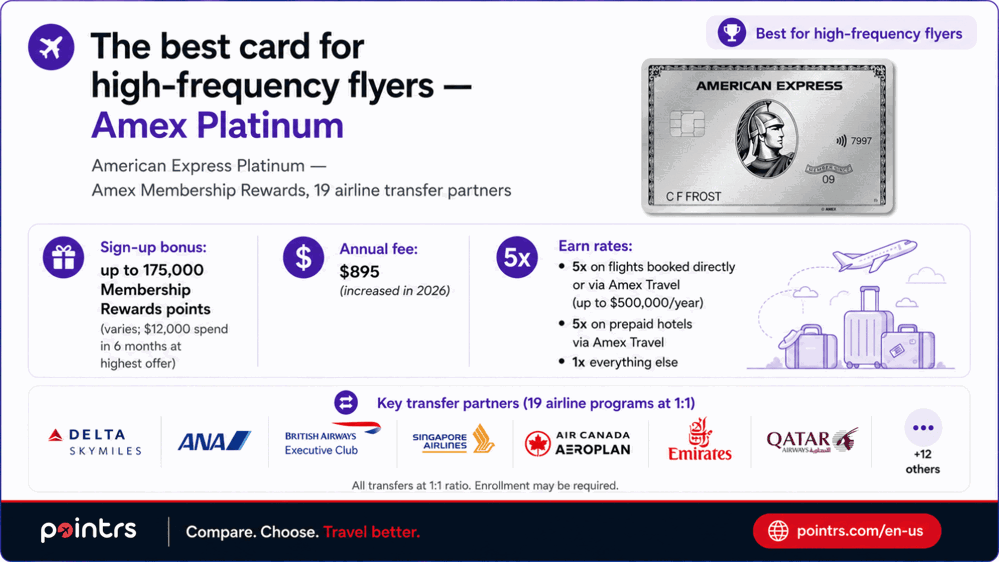
American Express Platinum — Amex Membership Rewards, 19 airline transfer partners
- Sign-up bonus: up to 175,000 Membership Rewards points (varies; $12,000 spend in 6 months at highest offer)
- Annual fee: $895 (increased in 2026)
- Earn rates: 5x on flights booked directly or via Amex Travel (up to $500,000/year); 5x on prepaid hotels via Amex Travel; 1x everything else
The Amex Platinum carries the highest annual fee of the premium trio at $895, but offers the largest potential welcome bonus of up to 175,000 Membership Rewards points after $12,000 spend in six months. The 5x earn rate on flights booked directly is the highest available on any major US card for air travel. Benefits include Centurion Lounge access, Delta Sky Club access, Priority Pass, Global Dining Access by Resy, Uber Cash, CLEAR Plus, and Marriott/Hilton elite status. Right for frequent flyers who book flights directly with airlines and will use the benefit ecosystem. Wrong for infrequent travellers or those who value simplicity.
The best mid-tier all-categories card — Citi Strata Premier
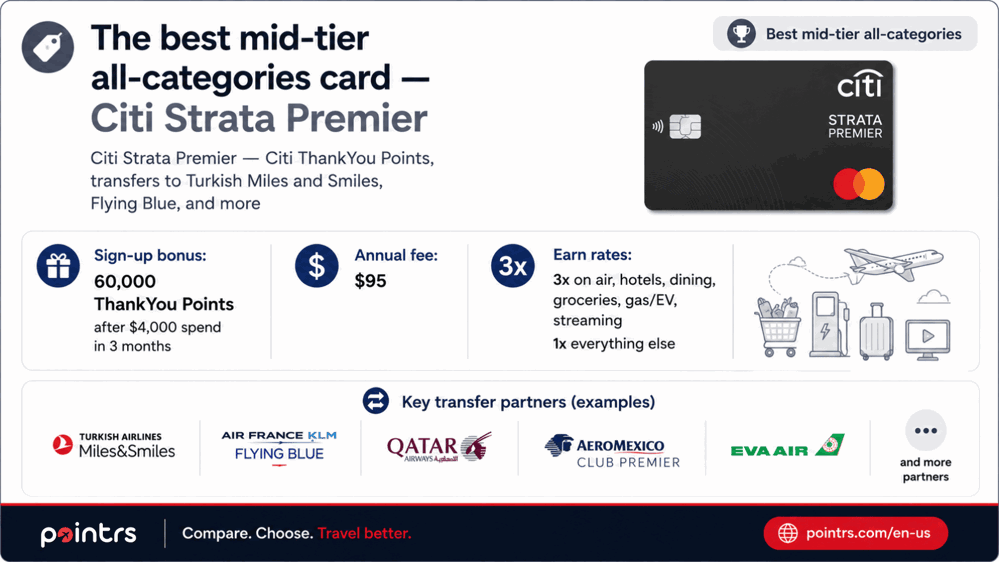
Citi Strata Premier — Citi ThankYou Points, transfers to Turkish Miles and Smiles, Flying Blue, and more
- Sign-up bonus: 60,000 ThankYou Points after $4,000 spend in 3 months
- Annual fee: $95
- Earn rates: 3x on air, hotels, dining, groceries, gas/EV, streaming; 1x everything else
The most underrated card at its fee level. The Citi Strata Premier earns 3x ThankYou points on air travel, hotels, dining, groceries, and gas — all with no caps and no foreign transaction fees. Its key transfer partners are the differentiator: Turkish Miles and Smiles (45,000 miles one-way US to Europe Business Class — one of the best remaining sweet spots), Air France Flying Blue, Avianca LifeMiles, and Cathay Pacific Asia Miles. Citi ThankYou points are valued at around 1.7 cents each, making the 3x earn rate equivalent to a 5.1% return on grocery and dining spend.
Best used alongside an Amex or Chase card to cover two major transfer ecosystems simultaneously.
Co-branded airline cards — when they make sense
Co-branded cards earn airline-specific miles and include card perks that general travel cards don't offer. The right co-branded card works as a complement to a flexible points card — not a replacement.
United Explorer Card — for United hub travellers
Free checked bag for you and a companion on United flights, priority boarding, two one-time United Club passes per year, and a sign-up bonus in MileagePlus miles. Best for travellers based near Chicago O'Hare, Houston Intercontinental, Newark, Denver, San Francisco, or Washington Dulles who fly United regularly. Pair with Chase Sapphire Preferred to route bonus-category spend into Ultimate Rewards and transfer to MileagePlus when needed.
Delta SkyMiles Gold Amex — for Delta hub travellers
Free first checked bag on Delta flights (saves $35 each way), 15% off Delta flights with miles, priority boarding, and Delta miles earn on everyday spend. Best for travellers in Atlanta, Seattle, Salt Lake City, Detroit, and Minneapolis. The card feeds into Delta SkyMiles but note that Delta uses fully dynamic pricing with no published award chart — meaning award costs fluctuate with demand. Most useful for the checked-bag saving rather than pure points earning strategy.
Citi Strata Elite — for American Airlines travellers
The sole remaining American Airlines consumer credit card issuer after the end of the Barclays partnership. Bankrate names it best for American Airlines loyalists. Includes preferred boarding, free checked bag, and AAdvantage miles earn. Best for travellers based in Dallas, Charlotte, Miami, Philadelphia, or Phoenix who fly American as their primary carrier.
What these bonuses can actually buy — live Pointrs
Chase Sapphire Preferred 100,000 points → New York to London Business Class return
Transfer 90,000 Chase Ultimate Rewards points to the right Star Alliance partner and book New York (JFK) to London (LHR) Business Class return — saving 310,000 miles against the standard 400,000 rate. The 100,000-point bonus covers this entirely with 10,000 points to spare.
👉 See this Pointr: New York to London Business Class return — from 90,000 miles
Amex Gold 100,000 points → Los Angeles to Tokyo Business Class return
Transfer 100,000 Amex Membership Rewards points to an Amex airline partner and book Los Angeles (LAX) to Tokyo (NRT) Business Class return — a $6,700 cash fare unlocked for $1,699 via miles. A saving of up to $5,001.
👉 See this Pointr: Los Angeles to Tokyo Business Class return — from $1,699 via miles
Capital One Venture X 75,000 miles → New York to Athens Business Class return
Transfer Capital One miles to a partner programme and book New York (JFK) to Athens (ATH) Business Class return for 100,000 miles — saving 85,000 miles against the standard 185,000. The 75,000 bonus plus a few months of 2x earning closes the gap.
👉 See this Pointr: New York to Athens Business Class return — 100,000 miles
Three things to check before applying
First: the 5/24 rule applies to Chase cards. If you have opened five or more credit cards in the past 24 months (with any issuer), Chase will deny the Sapphire Preferred or Reserve application. This is Chase's most important eligibility rule and it catches many applicants off guard. Check your card opening history before applying.
Second: Amex has a once-per-lifetime welcome bonus policy per card. If you have ever held the Amex Gold, Amex Platinum, or any other specific Amex card before, you may not be eligible for the welcome bonus on that card again — even if you no longer hold it. Amex sometimes makes exceptions, but the base policy is once per lifetime per card product. Amex now offers an online pre-approval tool that shows whether you are eligible for the current bonus before you apply.
Third: make sure the minimum spend requirement is achievable through spending you were already planning. A $5,000 minimum spend in three months for the Chase Sapphire Preferred is realistic for most households if the card is used for all everyday purchases. Artificially manufacturing spend — buying gift cards, moving money — is against card terms and creates unnecessary financial risk.

Earn More. Spend Less. Travel Better. — All card information is accurate as of July 30, 2026. Sign-up bonuses, earn rates, annual fees, transfer partner lists, and card benefits are subject to change without notice. Chase Sapphire Preferred 100,000-point offer ends July 30, 2026 at 3 PM Eastern. Chase Sapphire Preferred Hyatt transfer ratio change to 4:3 takes effect fall 2026 — verify current ratio before transferring. Amex Platinum annual fee confirmed at $895 in 2026 (increased from $695). Amex Gold annual fee confirmed at $325 in 2026. Capital One Venture X annual fee confirmed at $395. Point valuations (Chase UR at 2.05¢, Capital One at 1.85¢, Citi TY at 1.7¢) are third-party estimates from The Points Guy May/June 2026 and One Mile at a Time June 2026 — actual value depends on redemption. Amex once-per-lifetime bonus policy applies per card product — verify current eligibility using the Amex pre-approval tool before applying. Chase 5/24 rule applies to all Chase credit card applications. All Pointrs reflect award redemptions available as of July 2026 and are subject to change. Taxes, fees, and carrier surcharges are payable in addition to miles. This is general information only and is not financial advice.